
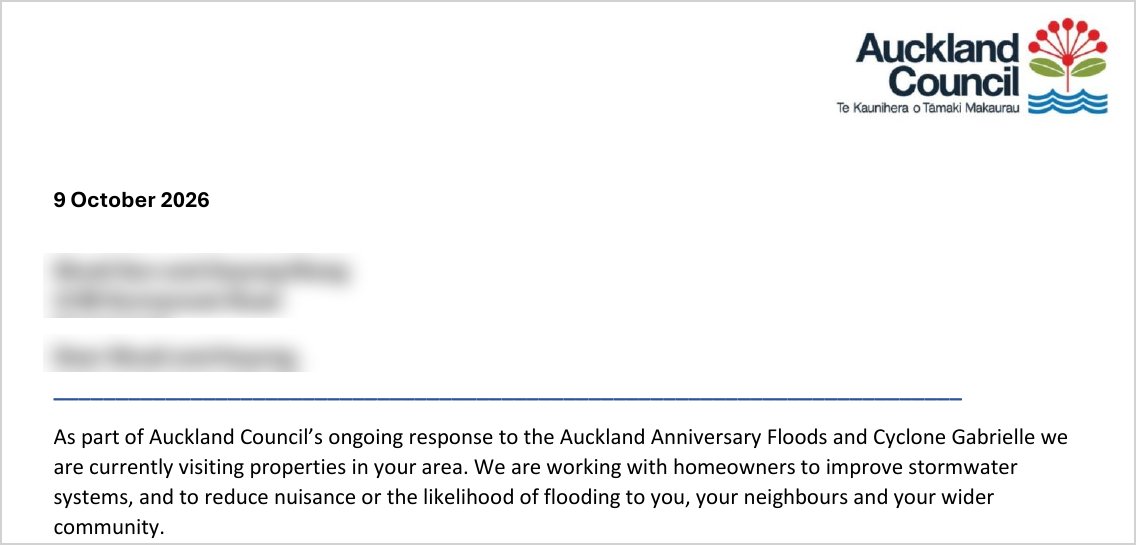
An Auckland Council stormwater letter usually arrives out of the blue. Someone from council walked past your property, took photos of your gutters, downpipes or gully trap, and now there is a report with the words “Stormwater Bylaw Breach” on it and a deadline.
It is not as alarming as it reads. Most of these letters are about ordinary maintenance or one pipe going to the wrong place, and the fix is usually a single visit. This is what the letter means, why council is sending them, and how to get the file closed.
The letter at the top of this page is a real Proactive Stormwater Visit letter, with the owner’s details removed. The part that matters is the breach table further down the letter, which tells you exactly what council wants fixed:
 The breach table from the same letter: blocked spouting on a shared carport and a catchpit full of sediment.
Why is Auckland Council sending stormwater letters?
There are two programmes behind most of the letters we see.
Proactive Stormwater Visits. After the Auckland Anniversary floods and Cyclone Gabrielle, council’s stormwater compliance team started going house to house in affected areas. They check the parts of your property that carry rainwater: spouting, downpipes, catchpits (also called cesspits), and the drains between them. If something is blocked or broken, you get a letter titled “Proactive Stormwater Visit” with a short breach table and photos.
Safe Networks inspections. This is a joint Watercare and Auckland Council programme aimed at keeping wastewater out of streams and off beaches. The inspectors are looking for stormwater going into the wastewater system and the reverse. The classic finding is a downpipe connected to the gully trap, which sends roof water into the sewer. Watercare says the rain from one house can take up as much room in the pipe as the wastewater from more than 40 households, which is how sewers overflow in heavy rain. In the Eastern Bays alone, crews inspected over 4,000 properties and found issues at more than 200.
What does a Stormwater Bylaw breach mean?
The letter will quote the Auckland Council Stormwater Bylaw 2015. The key part is clause 16: the owner and manager of a private stormwater system must keep it “in good operating condition” and make sure it does not cause a nuisance.
The bylaw spells out what counts as your private stormwater system. It includes pipes, gutters, downpipes, catchpits, subsoil drains and rain tanks, all the way to where your pipe meets the public network. So if the letter mentions your spouting or a blocked catchpit in the driveway, it is pointing at something the bylaw says is yours to look after.
The common findings, from the letters we have dealt with:
- Spouting blocked with leaves or vegetation
- Catchpit blocked with silt and sediment
- Downpipe discharging onto the ground instead of into a stormwater pipe
- Downpipe connected to a wastewater gully trap
- Gully trap too low, so rainwater can run straight into it
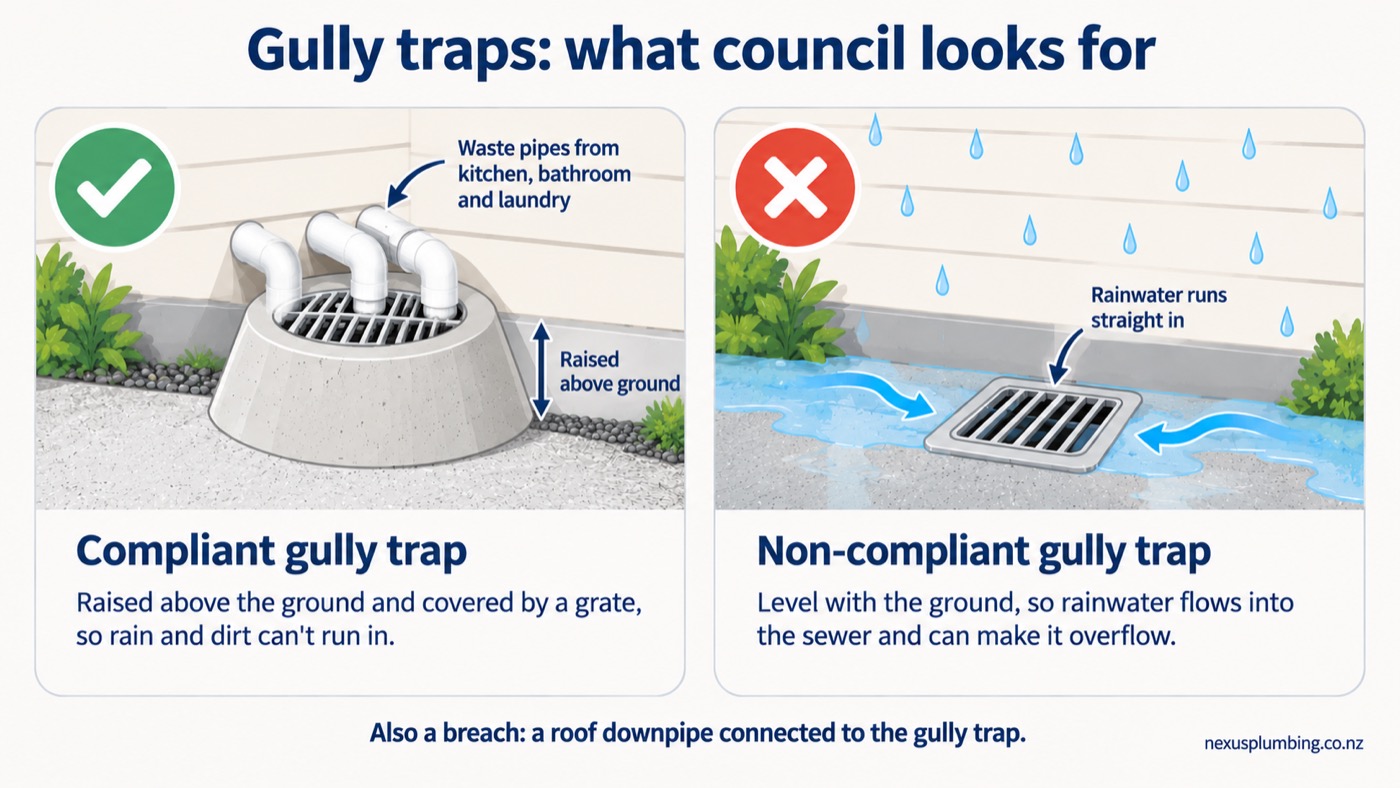 A compliant gully trap sits above the ground and only takes waste pipes from the house. One that is level with the ground lets rainwater straight into the sewer.
Who is responsible for the work, and who pays?
The property owner. Under the bylaw, owners, occupiers and managers are jointly and individually responsible for compliance, which is why a letter can land with a tenant, a landlord or a property manager. In practice the owner pays for the repair and the tenant’s job is to give access.
Shared driveways and carports are where it gets awkward. If the blocked gutter or catchpit serves more than one unit, the cost is normally shared through the body corporate or between the owners on the cross-lease. That is a conversation for the owners to have, but it should not hold up the work. Council wants the problem fixed; how the bill is split is a separate matter.
Public stormwater drains in the street are council’s responsibility. If the problem is on the road side of your boundary, call council on 09 301 0101.
How the work actually gets done
What it involves depends on the finding.
Blocked spouting and catchpits are a cleaning job. We clear the spouting, flush the downpipes, and dig the silt out of the catchpit sump so the outlet is free. If we find damage while we are up there, such as a rusted section of gutter or a cracked downpipe, we photograph it and quote it separately.
A downpipe going onto the ground needs a new pipe to the nearest stormwater point. On a Glenfield job, the carport downpipe was emptying onto the driveway, so we cut the concrete, laid a new pipe to the existing cesspit, tested it and reinstated the surface.
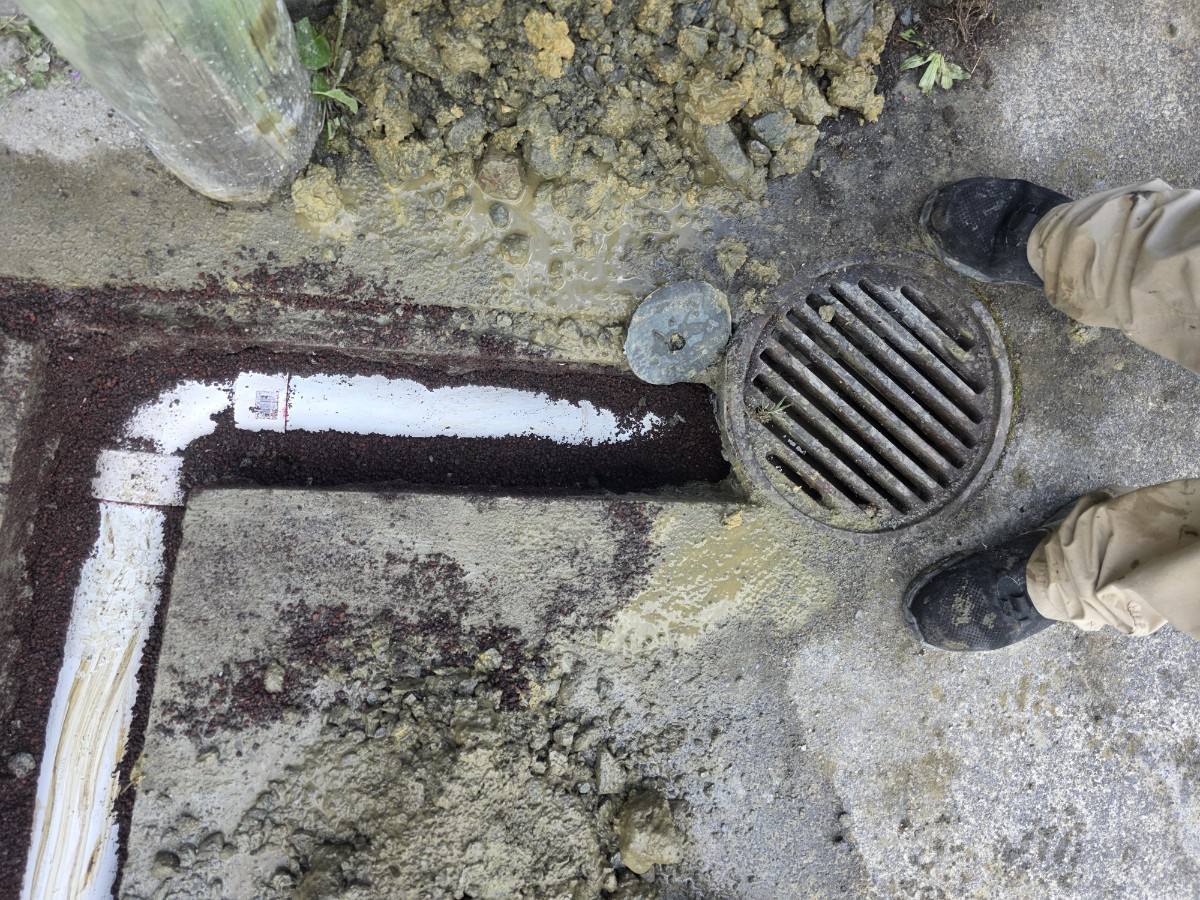 Glenfield: the carport downpipe now runs into the cesspit instead of across the driveway.
A downpipe in the gully trap has to be redirected into the stormwater system. Before anyone digs, it is worth finding out where the stormwater pipes actually run. We start with the council property file and drainage plan, and if the plan does not match what is on site we put a camera down the line. Guessing here is how you end up digging the same trench twice.
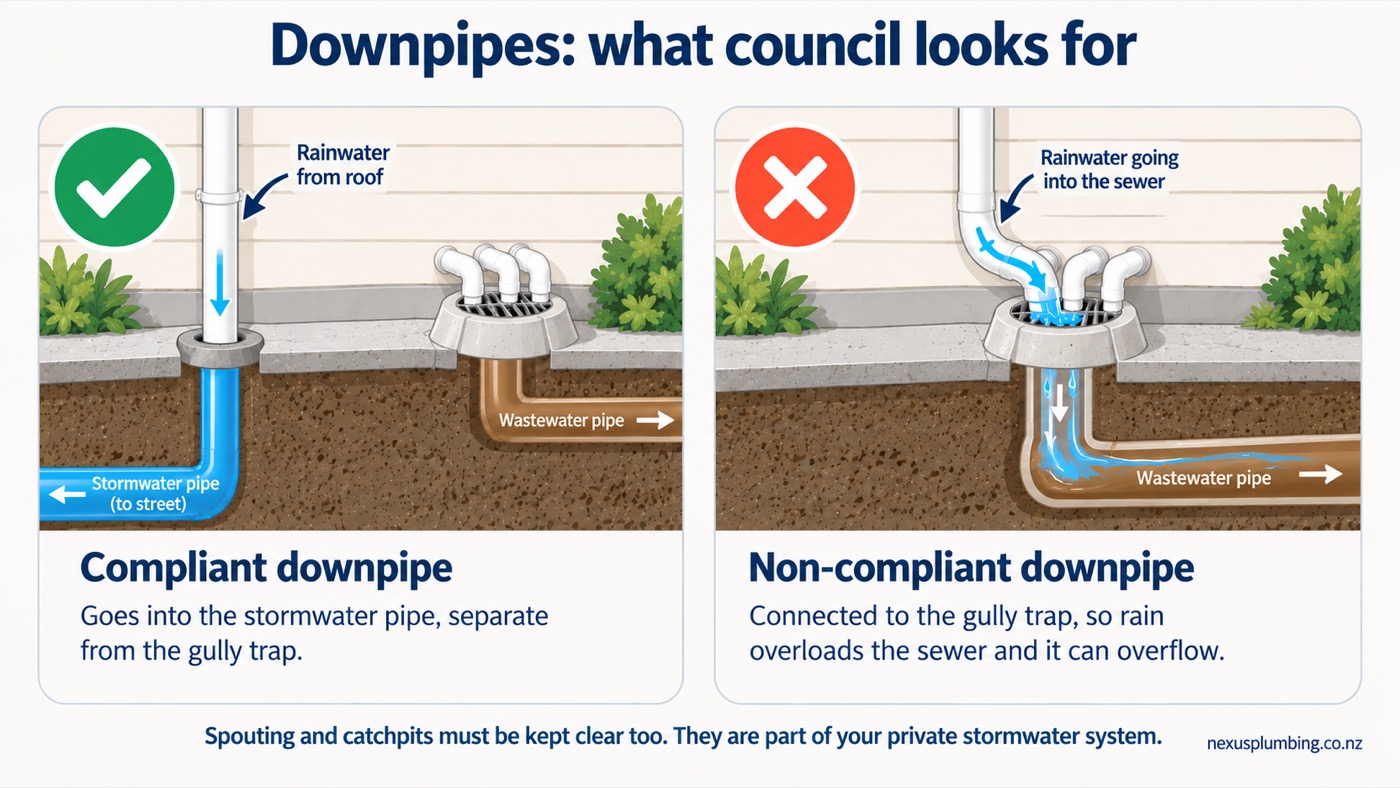 Roof water and household wastewater should leave the property in separate pipes. A downpipe into the gully trap puts rain into the sewer.
A low gully trap gets raised. The surround has to sit above the ground so rain cannot flow in. In Kohimarama, a Safe Networks letter listed both a downpipe in the gully trap and traps that were too low. We redirected the downpipe to stormwater and raised the gully traps with new concrete haunching, 100 mm above the unpaved ground.
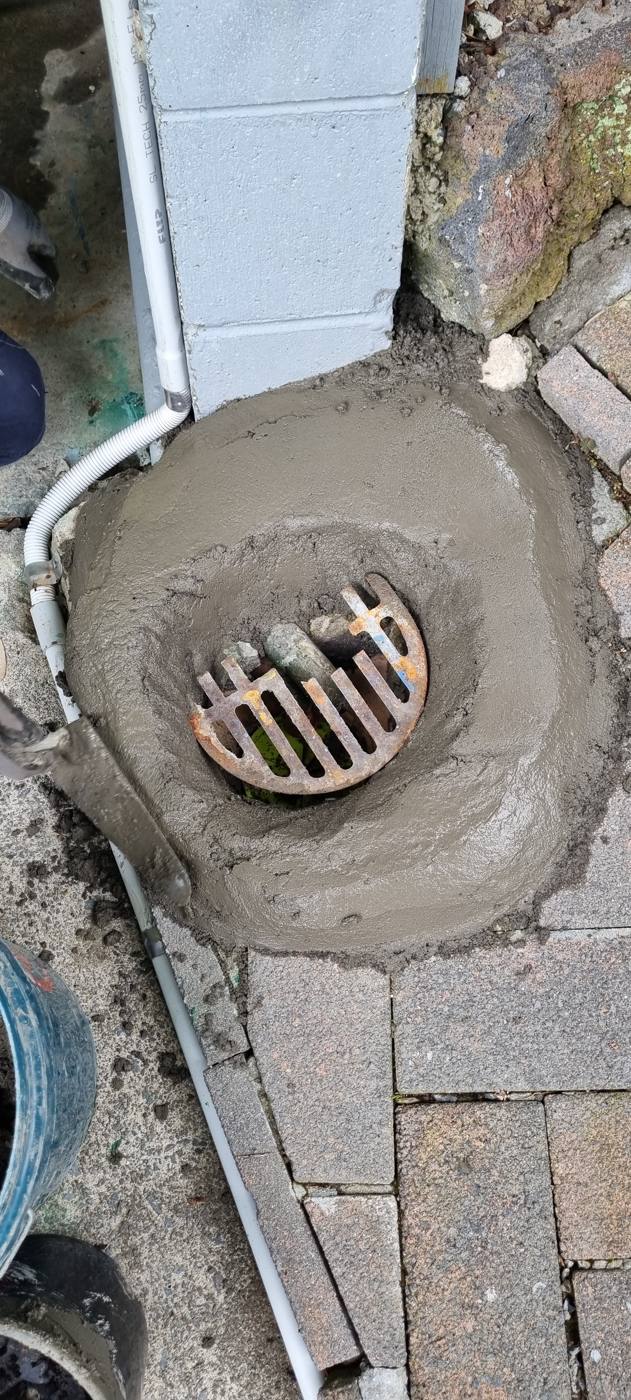 Kohimarama: gully trap raised above the ground and the downpipe taken out of it.
How do I close the file with council?
The letter will say what council needs, which is usually photos of the completed work emailed to the compliance officer named at the bottom. Before and after photos from the same angle as council’s own photos make it quick for them to sign off.
We take those photos as part of the job and send them to you ready to forward, so the last step is not left to you.
What you can do before you call anyone
- Read the breach table. It is short, and it tells you exactly what council saw.
- Check the deadline. Proactive Stormwater Visit letters usually give four weeks.
- If you are a tenant, send the letter to your landlord or property manager straight away.
- If you are the owner of a unit, tell the other owners or the body corporate if anything shared is listed.
- If you need more time, contact the officer on the letter. They would rather hear from you than chase you.
- Send us a photo of the letter, including the breach table and council’s photos. By email or through the enquiry form on our website, this is the fastest way to get an accurate answer, because we can see exactly what council found before anyone visits.
Common questions
What happens if I ignore an Auckland Council stormwater letter?
Council will follow up, often with another visit. If the problem is still there it can issue a formal Bylaw Notice with a deadline, and in serious cases it can do the work itself and recover the cost from the owner. A conviction under the bylaw carries a fine of up to $20,000. Very few cases get anywhere near that, because most owners simply get the work done.
Do I need council approval to fix it?
Not for cleaning, or for redirecting a downpipe into your own existing stormwater pipes. Approval is needed for a new connection to the public stormwater network or for altering the public network itself. If your fix needs a new connection, we will tell you before any work starts.
Can a tenant be sent a stormwater letter?
Yes. The bylaw makes owners, occupiers and managers jointly responsible, so council can write to whoever is on the property. The repair itself is normally the landlord’s responsibility, so the tenant should pass the letter on quickly and give access when the work is booked.
Is it a plumber or a drainlayer I need?
For gutters, downpipes and catchpits, a plumber is fine. Anything below ground, like a new stormwater pipe or a raised gully trap, is drainlaying and has to be done by a licensed drainlayer. Our team is licensed for both, so one visit covers the whole letter.
How do I find where my stormwater pipes run?
Start with the drainage plan in your council property file. Council’s GeoMaps also shows the public stormwater and wastewater lines near your boundary. Older plans are often wrong about private pipes, so if the plan and the ground disagree, a CCTV camera inspection settles it before anyone digs.
Related reading
- Blocked drains in Auckland: what is blocked, whose pipe it is, and what happens next
- The gully trap is overflowing: what that actually means
- No more flood damage with subsoil drainage
- Basement water problems and what actually fixes them
- Who to call for a leak: the council, Watercare, or a plumber?
Got a letter from Auckland Council about your stormwater? The quickest way to an accurate answer is a photo. Email the letter and council’s photos to admin@nexuspgd.com, or upload them with our enquiry form, and we will tell you what the work involves and what it will take. Landlords and property managers are welcome to forward the letter straight to us. You can also call Nexus Plumbing. See what our drainage service covers.