
Auckland rain does not arrive gently. It comes in short, heavy bursts, and the ground cannot take it fast enough. Water that has nowhere to go finds the lowest opening in your house, which is usually a garage or a basement.
The frustrating part for homeowners is that this is rarely a plumbing fault. Every pipe on the property can be sound and the garage still fills up, because the problem is surface water rather than anything running through a pipe.
How do I know it is surface water and not a leak?
Check the meter first, because it takes a minute and it rules out the expensive possibility.
Turn everything off in the house and watch the water meter. If it is not moving, no pressurised pipe is leaking, and water appearing on your property is coming from rain, from the ground, or from somewhere upstream of you. The one minute meter check walks through it.
Other tells: it only happens when it rains or shortly after, the water is clean rather than smelly, and it arrives from one direction across the ground rather than welling up in one spot.
A real case: ankle deep in the garage
We were called to a house in South Auckland that had been flooding for some time. On heavy rain days water accumulated in the garage and rose to ankle height.
The homeowners assumed a burst pipe or a drainage failure. On inspection there were no leaking pipes and no sewage problem at all. The house sat on a slightly elevated plot, and water from the back lawn was pooling and running towards the building instead of draining away. The soil could not absorb it fast enough, so it banked up against the house and started working on the foundation.
Nothing about that is fixable with plumbing. It needed somewhere for the water to go.
What subsoil drainage actually is
A perforated pipe laid below ground in a trench of drainage metal, positioned to catch water before it reaches the building and carry it somewhere safe.
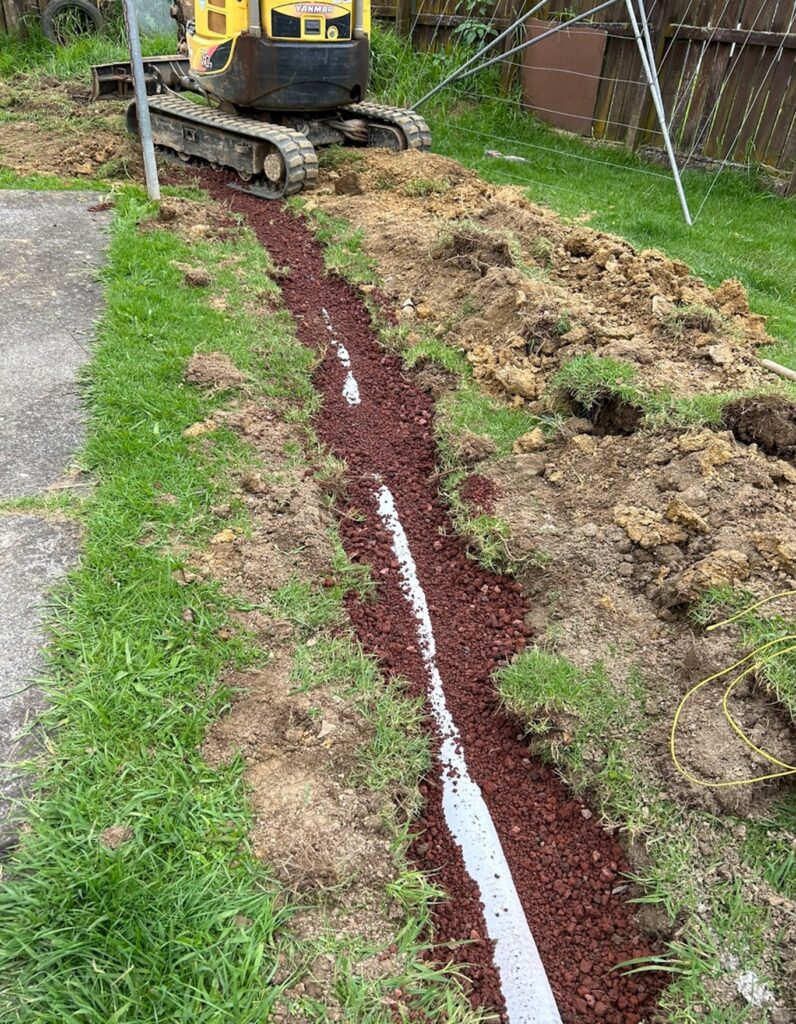
We generally use Novacoil, a corrugated perforated pipe that lets groundwater in while keeping soil out. On that South Auckland job we ran it around the perimeter and through the areas where water was collecting, and discharged it to a cesspit.
The result was immediate. The garage stopped flooding, and more importantly the foundation stopped having water sitting against it every time it rained.
The principle is simple: intercept the water uphill of the problem and give it a lower place to go than your house.
Whose house needs this?
Not every property. The ones where it earns its cost:
- Homes with a basement or a garage below ground level. These are the most vulnerable, because water only has to get slightly above floor level to get inside.
- Houses on a slope. Water gathers speed and volume coming downhill, and a house partway down a section is directly in the path.
- Uneven ground that stays soggy. Persistent boggy patches and puddles that never dry mean water is sitting rather than moving.
- Sections with a lot of concrete. Driveways, patios and paving stop water soaking in and send it somewhere else instead, and that somewhere is often the house.
If your problem is a persistently damp patch rather than actual flooding, that may be groundwater surfacing naturally and not need anything at all. Who to call for a leak covers how to tell groundwater, stormwater and a genuine leak apart.
What does the work involve?
An excavator, a trench along the line the water travels, the perforated pipe bedded in drainage metal, a filter layer to stop the trench silting up, and a connection to a discharge point. Reinstating the ground afterwards is part of it.
The design matters more than the digging. Getting the line and the fall right is what makes it work, and a trench in the wrong place is an expensive way to achieve very little. We look at where water actually arrives from during rain rather than where the low point appears on a dry day.
Keeping it working
Subsoil drainage is not maintenance free, though it does not ask much.
- Check it before and after winter, and look for blockage or damage at the inlets and the discharge.
- Keep the intake areas clear of leaves and debris.
- Walk the property after heavy rain and watch where water goes. Pooling that was not there last year is the early warning.
If your garage takes on water when it rains, send us a photo of where the water comes from and where it collects. That is usually enough for us to say whether this is a drainage job or something else.
Common questions
Is this a plumber’s job or a builder’s?
Drainlaying, and it is licensed work in New Zealand. We hold the drainage side in house rather than subcontracting it, which matters because the discharge point and the connection have to be done properly. Where a retaining wall or concrete work is needed as well, a builder does that part and we work alongside them.
Will it stop my basement leaking through the walls?
It stops water sitting against the wall, which is the cause in most cases. If water has been getting through for years, the wall itself may also need attention on the inside, and that is a different trade. The usual order is to remove the water first and then see what is actually still wet, because a lot of apparent wall problems dry up once the ground beside them does.
Can I just dig a trench and put a pipe in myself?
Physically yes, and people do. What goes wrong is fall, filter material and discharge. A pipe with no fall holds water instead of moving it, a trench without the right metal and filter silts up within a season or two, and a discharge that dumps water onto a neighbouring property creates a different problem entirely. It is also drainlaying, which is restricted work.
Where is the water allowed to discharge to?
To a legal stormwater connection, a cesspit or an approved outlet, not simply onto the next section down the hill or into the wastewater system. Getting that wrong can make you liable for a neighbour’s flooding. We work that out as part of the design rather than at the end.
How long does it take?
Most residential jobs are one to two days on site depending on the length of the run and what has to be dug through. Concrete or an established driveway in the path adds time and cost, which is why we look at routing around hard surfaces first.
Related reading
- The gully trap is overflowing: what that actually means
- Basement water problems and what actually fixes them
- The ground is wet and nobody knows why: underground leaks
- Who to call: council, Watercare, or a plumber
- The one minute meter check, step by step
- Blocked drains in Auckland: what is blocked, whose pipe it is, and what happens next
Subsoil work is worth doing once and doing properly, because the trench only gets opened once. See what our drainage service covers, or call 021 837 775 and describe where the water sits after rain.