
Most people meet their hot water cylinder twice: the day it is installed, and the day it stops working. If you are reading this it is probably the second one. A cold shower this morning, or a puddle spreading across the garage floor, and now you want to know whether this is a part or a whole new tank, how long you will be without hot water, and whether the price you are quoted is the price you will pay.
Here is the whole picture, in the order you will actually face it. We repair and replace cylinders across Auckland every week, so what follows comes from our own jobs rather than a brochure.
First: is the cylinder actually the problem?
Do not assume the worst yet. If the water has simply gone cold and nothing is leaking, the fault is often not the tank at all. It is the element, the thermostat, or just the power supply to the cylinder. We have been called to “dead cylinders” that turned out to be a breaker switched off after a meter upgrade.
Check the kitchen hot tap. If it runs cold, the element or the power is the likely cause, and an element is a standard part to replace. If the hot tap gives you nothing at all, not even cold, the problem is upstream of the cylinder and worth a plumber’s visit.
A cylinder only a few years old that suddenly gives you nothing is far more likely to have an electrical fault than a dead tank. Here is a Henderson home with no hot water where the cylinder was fine.
One more thing people ask: the outside of the cylinder does not feel hot, and the pipe coming out of it does. That is normal. The tank is insulated to keep the heat in, and the pipe is carrying hot water.
Water around the cylinder: is it the tank, or a valve?
Water on the floor does not always mean the cylinder has burst. Several parts hang off it: the pressure limiting valve, the tempering valve, the cold water expansion valve, the relief valve and the isolating valve. If one of those is faulty, or a connection between them has failed, water leaks and wets the carpet, and that is a repair.
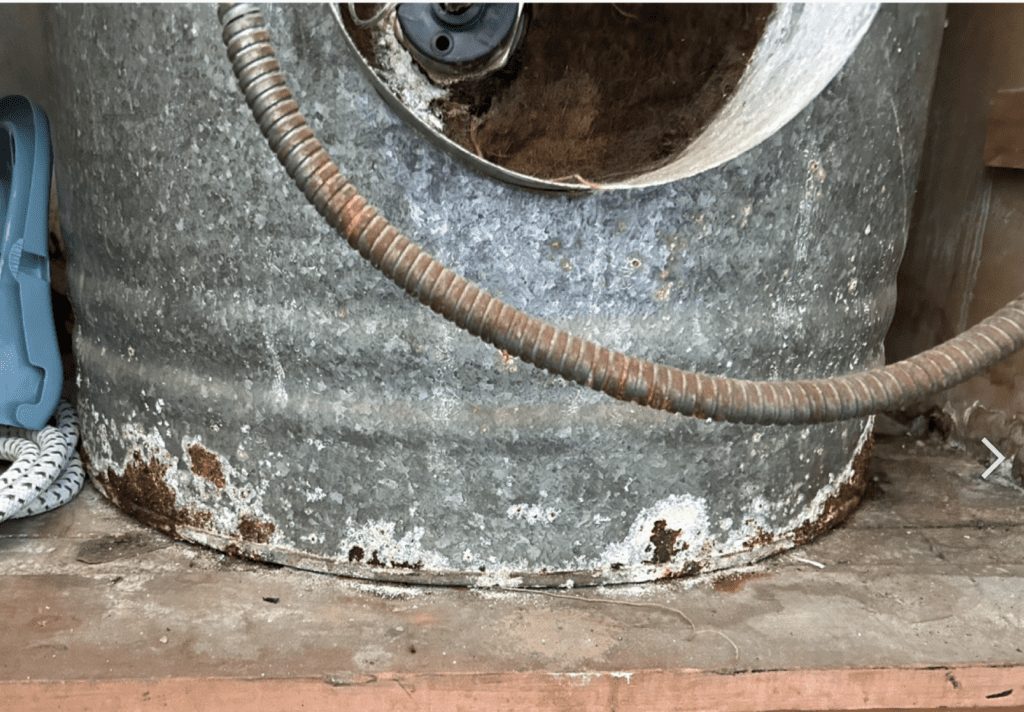
The one that means replacement is water coming from the body of the tank itself, usually from the bottom. Once the tank has rusted through, no valve or element will save it.
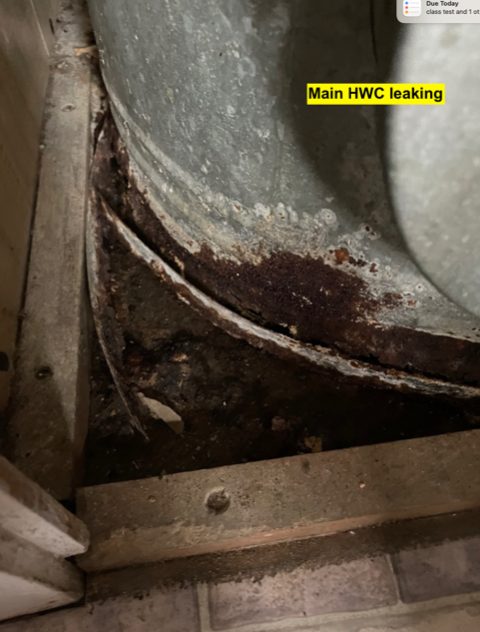
If you are not sure which you are looking at, Water Under the Hot Water Cylinder walks through the three places to look and what each one means.
What to do right now. Close the valve on the cold feed into the cylinder, and turn off its power at the switchboard. If you cannot find the valve, take a photo of the cylinder and its pipework and email it to admin@nexuspgd.com; we will mark the shut-off point on the photo and send it back. Checking a photo is always free.
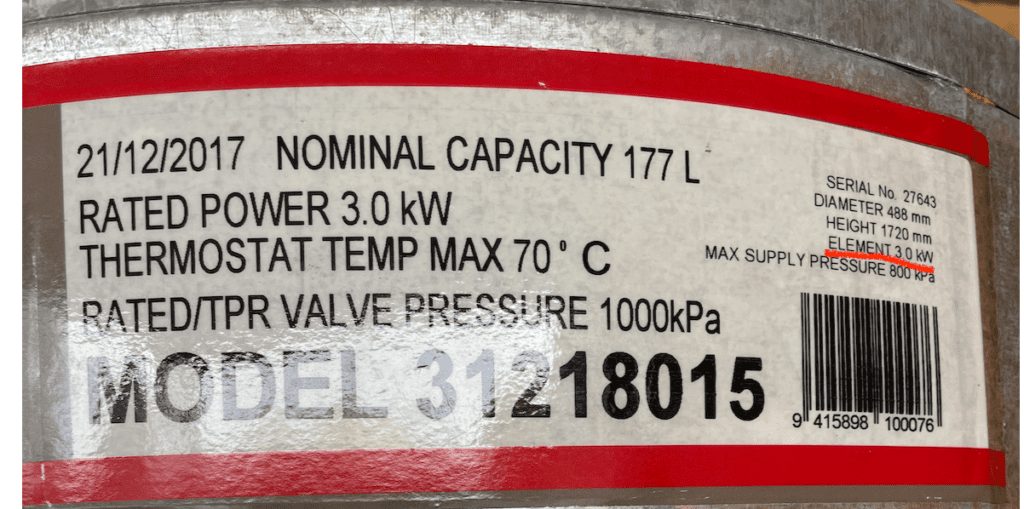
What to send us. A photo of the label on the cylinder. It shows the manufacturing date, the capacity and the model, and from that we can arrive with the right parts on the van rather than making two trips.
Two other symptoms that get mistaken for a failing tank
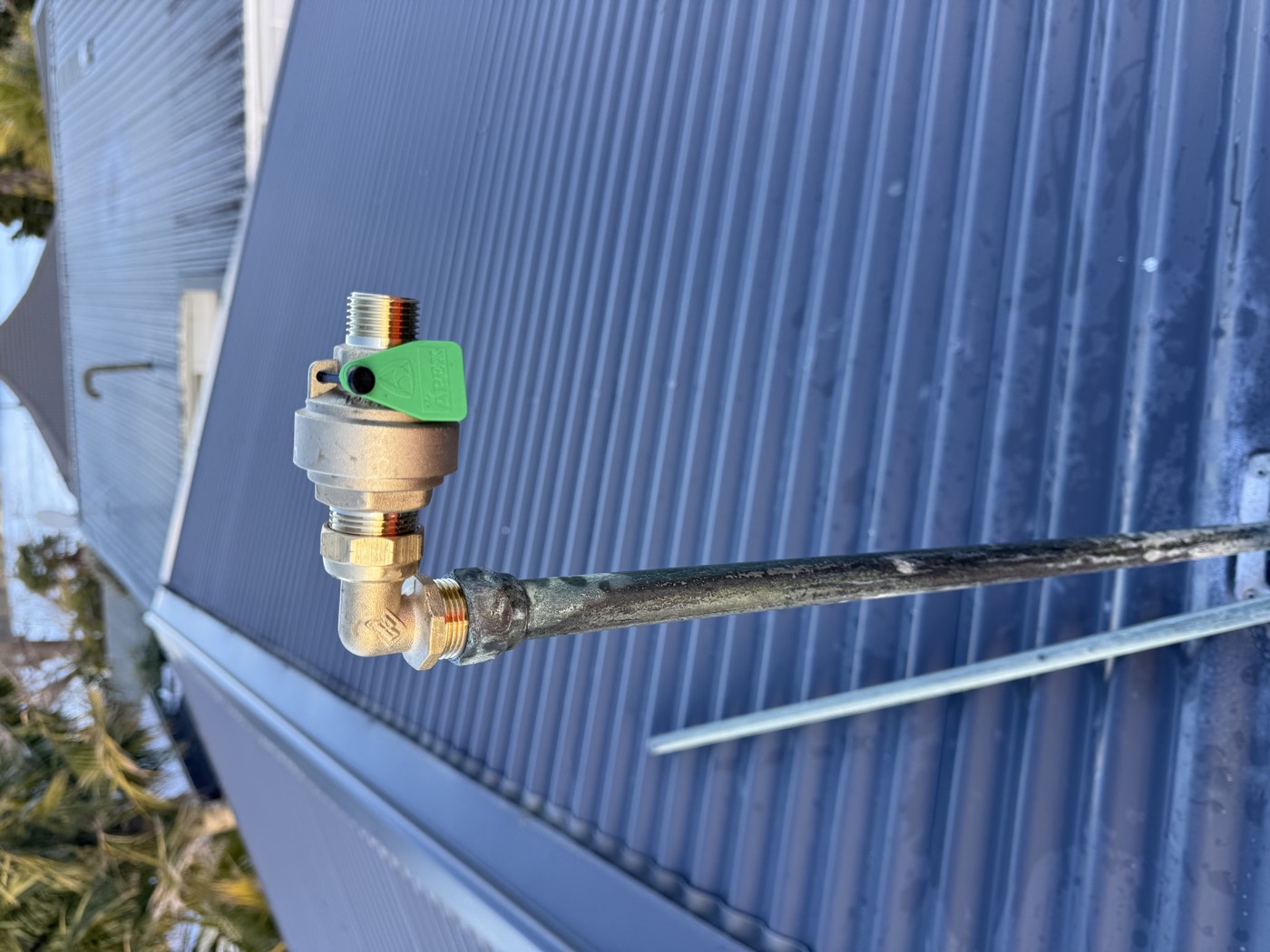
Water dripping from a pipe on the roof. That pipe is the vent on a low pressure cylinder, and a little water from it now and then is normal. Constant flow is not. It usually means a control valve has failed, and it quietly puts heated water onto the roof, which shows up as a higher power bill before it shows up anywhere else. Why is water running out of the pipe on my roof? covers it properly.
Noise. Humming, knocking, tapping or a screech from the cylinder is nearly always a valve or the pressure, not the tank about to fail. Turn off the power and have it looked at, but it is rarely urgent. What each noise usually means.
Repair or replace?
The rule we use on site:
- Element, thermostat or valve fault on a sound tank: repair it. These are standard replaceable parts.
- Tank body leaking, or a mains pressure cylinder past 10 to 15 years with a fault: replace it. Repairing a tank near the end of its life means paying twice.
- Low pressure copper cylinders often live 20 years and more, so age alone is not a reason to replace one.
There is one honest caveat on the repair side. On an old cylinder the valves are the same age as the tank, and once one starts going the next one tends to follow. If we are replacing a valve on a cylinder that is well into its life, we will say whether it is worth doing or whether the money is better put toward the tank.
How long a hot water cylinder lasts
Mains pressure steel cylinders: typically 10 to 15 years. Low pressure copper: 20 to 40 years is common, and we still meet ones older than that. If yours is inside its window and misbehaving, repair first. Past it, put the money toward a new tank.
What actually happens on replacement day
This is the part nobody explains, so here it is.
A like-for-like swap, meaning the same size, same spot and same pressure type, is usually done in half a day. We isolate the water and power, drain the old tank, disconnect it, fit the new cylinder, connect the water, fit the safety gear current rules require, and refill. You will have hot water again the same evening, because a full tank takes a few hours to heat from cold.
You do not need to be home the whole time. We need access at the start, and someone to walk through the result at the end. The old cylinder leaves with us.
Current rules require seismic restraint straps, so the cylinder cannot topple in a quake, and your old install may not have had them. They are part of a proper install, not an upsell.
Where the quote can grow, and why
Nobody likes surprise extras, so here is where they actually come from. If none of these apply to your place, your quote is your price.
- Electrical reconnection. The cylinder’s wiring has to be reconnected, and depending on what is found at the switchboard this is sometimes an electrician’s job rather than ours. We tell you before work starts, not after.
- Old pipework that will not take a new fitting. In older homes the pipe next to the cylinder can be too tired to connect to. If we can see it coming, it goes in the quote up front.
- Changing size or moving the cylinder. A bigger tank or a new location means new pipe runs. That is a scope change, and we price it before touching anything.
- Low pressure to mains conversion. Worth doing if you hate your shower, but it is a different job from a swap. More on that below.
Our quotes state what is included and what is excluded, line by line. If you have had a quote from anyone that does not, ask why.
What size do you actually need?
- 135 litres suits one or two people.
- 180 litres is the standard for a household of three or four, and it is what we install most.
- 250 to 300 litres suits five or more, long-shower teenagers, or a big bath habit. A 300 litre tank lets a household of six shower back to back without the water going cold.
If the hot water runs out mid-shower every evening, the tank is undersized for how you live, and swapping like for like just buys the problem again. When we quote we ask how your household actually uses water before recommending a size.
The alternative to a bigger tank is a gas continuous flow unit outside the house, which never runs out because it heats water as it flows. If your street has piped gas it is worth pricing both. No hot water on a gas system explains the two gas types if you are not sure which you have.
Will the new one fit where the old one is?
Often not, and this catches people out because they are thinking in litres rather than centimetres.
Modern cylinders carry more insulation than the ones they replace, so the same capacity takes up more space. A 180 litre tank today is a physically bigger object than a 180 litre tank from twenty years ago, and the cupboard or alcove built around the old one is frequently too tight for it. We check the space before quoting rather than discovering it on the day with the old cylinder already out.
When it does not fit, there are three ways forward:
- Go slightly smaller to stay in the space. Only sensible if the old size was generous for the household.
- Open the space up. Widening a cupboard or removing a bit of framing is usually building work alongside ours.
- Move it outside. Mains pressure cylinders can be installed externally, and it is worth considering rather than treating as a last resort. It gives you the cupboard back, takes the tank out of the living space, and often makes the pipe runs and the relief discharge simpler. It does mean new pipe runs and a proper base, so it is priced as a relocation rather than a swap.
If your cylinder sits in a cupboard you would rather have back, say so when we quote. It is a much easier decision while the wall is open anyway.
Low pressure or mains pressure?
If your shower dribbles while the kitchen tap roars, you probably have a low pressure cylinder. They are slow but tough. Mains pressure cylinders give you the strong shower everyone wants and typically last 10 to 15 years.
Replacement time is the natural moment to upgrade from low pressure to mains, because the labour overlaps. It involves more than swapping tanks, since the pipework and the valve set are different, so it is quoted as its own job. If you are weighing it up, tell us and we will quote both so you can compare. Here is a Titirangi bathroom where we upgraded the cylinder before the tiles went on, which is the right order.
Thinking about a heat pump cylinder instead?
Heating water is close to a third of a typical New Zealand home’s energy use, which is why heat pump cylinders are getting attention: they heat the same water using roughly a third of the electricity of a standard element.
They are not right for every house. The unit lives outdoors, it needs clear space above it for servicing, and the economics depend on your household size and power plan. We install them and we will tell you honestly whether your place suits one. That conversation is free, and it is a lot cheaper than finding out after the concrete pad is poured.
Running costs, and the one setting you should not touch
Do not turn the thermostat down to save power. The water in the tank has to be stored at 60°C or above. Below that, Legionella bacteria can grow in the cylinder, and the New Zealand rules set 60°C as the minimum for exactly that reason. The tempering valve brings it down to a safe temperature at the tap, which is why you need both.
Use an off-peak window if your plan has one. A cylinder takes two to three hours to reheat, and hot water is close to a third of most households’ power use. If your retailer gives you free or cheaper power in an evening window, showering during it means the reheat happens on the cheap rate.
Winter bills go up on their own. A cylinder loses more heat when the air around it is cold, so it works harder to hold temperature. Part of the winter jump is that, not a fault.
A constant drip from the roof vent is a running cost. See above. It is heated water leaving the house.
Selling the house, and what the building inspector will say
Since the Christchurch earthquakes, new installations have to be seismically restrained. A cylinder installed ten or more years ago may not be, and inspectors flag it.
The good news is that those rules apply to new installations. For an existing cylinder they are recommended rather than mandatory, so on their own they should not block a sale. When the cylinder is eventually replaced, the new install has to comply, and that is when it gets done.
If it leaks and damages the house: insurance
The damage a leaking cylinder does to floors, walls and carpet is usually claimable as sudden damage. The plumber’s visit and the repair or replacement of the cylinder itself normally is not. What the insurer will want is a plumber’s report saying what failed and when, and one sentence in that report matters more than the rest. If you are looking at a claim, here is how a water leak claim actually runs.
Common questions
How long does a hot water cylinder take to heat up?
From stone cold, a standard 180 litre electric cylinder takes a few hours to fully heat. That is why a same-day swap still means hot showers that night.
Can I replace a hot water cylinder myself?
Cylinder work sits under New Zealand’s restricted plumbing rules, and the electrical side has to be done by someone authorised to do it. Beyond the legal side, an uncertified install can void your insurance on the day you need it most. This is one to hand over.
Do you take the old cylinder away?
Yes. Disposal is part of the job. Nothing gets left on your lawn.
My house has two cylinders. Do I need both?
Not always. If the existing pipework allows the house to run from one cylinder, reducing two cylinders to one can be a good option. Depending on the household’s hot water demand, however, the remaining cylinder may need to be upgraded to a larger capacity. Running one appropriately sized cylinder instead of keeping two heated can also reduce electricity use.
There is one trade-off. Combining the hot water pipework into one cylinder may increase the distance between the cylinder and some taps or showers, and the farther a fixture is from the cylinder, the longer hot water takes to arrive. That is because the cold water already sitting in the hot pipe has to run out first before freshly heated water reaches the fixture. Fixtures closer to the cylinder get hot water sooner, and fixtures farther away take longer. A Manukau house with two cylinders is a worked example.
The cylinder is leaking but I think it is just a valve. Can you replace only that?
If the water is coming from a valve or a fitting, yes, and that is what we would recommend on a cylinder that is not near the end of its life. If it is coming from the tank body, or the tank is old enough that the next valve is likely to go soon after, we will tell you the tank is the better use of the money.
Is water dripping from the pipe on the roof an emergency?
An occasional drip is normal. A constant flow is a fault that costs you money every day it runs, so it is worth fixing promptly, but it is not dangerous.
Related reading
- Water under the hot water cylinder: four things it could be
- Why is water running out of the pipe on my roof?
- What that noise from your cylinder really means
- No hot water in Henderson, and the cylinder was not the problem
- No hot water on a gas system: storage, continuous flow, and which you have
- Manukau: a house with two hot water cylinders, do you need both?
- Brown water from the tap: what it is and what to do first
- Hot water not hot? Stone cold and lukewarm are different faults
If your hot water has stopped or your cylinder is leaking, call us or get a quote. Same-day response across Auckland. See our hot water service, or browse cylinders and prices.