
When someone rings about hot water, the first thing we ask is not how old the cylinder is. It’s this:
Is the water stone cold, or is it warm but never properly hot?
Those are two different faults with two different answers, and one of them isn’t even a plumbing job. Getting this one distinction right before anyone comes out will save you a call-out, and occasionally a great deal more than that.
Stone cold: it’s usually electrical — but check the cylinder’s age first
If an electric cylinder is delivering genuinely cold water, the stored water isn’t being heated. That points at the element or the thermostat, and neither of those is plumbing work. An electrician does that.
The two are easy to confuse, so briefly:
- The element is the heater itself — a coil sitting inside the tank, in the water. When it burns out, nothing heats at all and you get cold water.
- The thermostat is the control that decides when the element switches on and at what temperature it stops. When it fails or has been wound down, the element may be perfectly good but never gets told to do enough work.
Same symptom from the outside, different part, and an electrician tests which one it is in a few minutes.
So the obvious next step is to ring an electrician. Before you do, answer one question: how old is the cylinder?
Here’s why it matters. Replacing an element means draining the cylinder completely and then refilling and re-pressurising it. On a tank that has sat full and under pressure for fifteen or twenty years, that drain-and-refill is exactly the kind of thing that finds the weak spot. We have seen cylinders fail during that process — the element gets replaced and the tank then lets go, and now you are paying for both, plus whatever the water damaged on its way out.
If the cylinder is young, get the electrician in and the element or thermostat is very likely the whole story. If it’s old, the honest question is whether you are about to spend money on a part inside a tank you should be replacing anyway. That’s worth thinking about before the electrician arrives, not after.
How long should a cylinder last?
As a rough guide:
- Mains pressure — around 10 years
- Low pressure — around 20 years
These are averages and nothing more. Your water pressure and your water quality move them a long way in both directions, and we have pulled out mains pressure cylinders that were failing at seven years and others still going at fifteen. Use the numbers to decide whether it’s worth asking the question, not to predict a date.
Lukewarm: the most likely answer is the least interesting one
If the water is warm rather than cold, the most common cause by a distance is not a fault at all. You used it all.
A cylinder holds a fixed amount of hot water and reheats over hours, not minutes. A 180 litre cylinder is roughly two long showers. The second person gets a decent shower; the third gets what’s left mixed with cold, which is lukewarm. Nothing is broken. The household has simply outgrown the tank, or the showers have got longer.
You can usually recognise it:
- It’s properly hot first thing in the morning and disappointing later
- It’s fine on some days and not others, depending on who showered when
- It got noticeably worse when the household grew, or someone moved in
- Wait a few hours and it comes right on its own
If that’s the pattern, this is a capacity conversation — a bigger cylinder, or reheating at a different time of day — not a repair.
Lukewarm at any time of day, no matter how long you wait
Now it’s a fault, and there are three realistic candidates.
The thermostat. If it has failed or been wound down, the stored water never reaches temperature in the first place. The element is fine, it’s just never asked to finish the job. Electrician.
The element — but only partly gone. A burnt-out element gives you cold water, not warm, so people rule it out too early. What catches them is an element that is still working but not working well: heavily scaled up, or one of two elements dead in a twin-element cylinder. The tank still heats, just slowly and not all the way, so you get water that is warm, recovers far more slowly than it used to, and runs out sooner than it should. If your hot water has been quietly getting worse over months rather than failing one morning, this is worth testing. Electrician again.
The tempering valve. Ours.
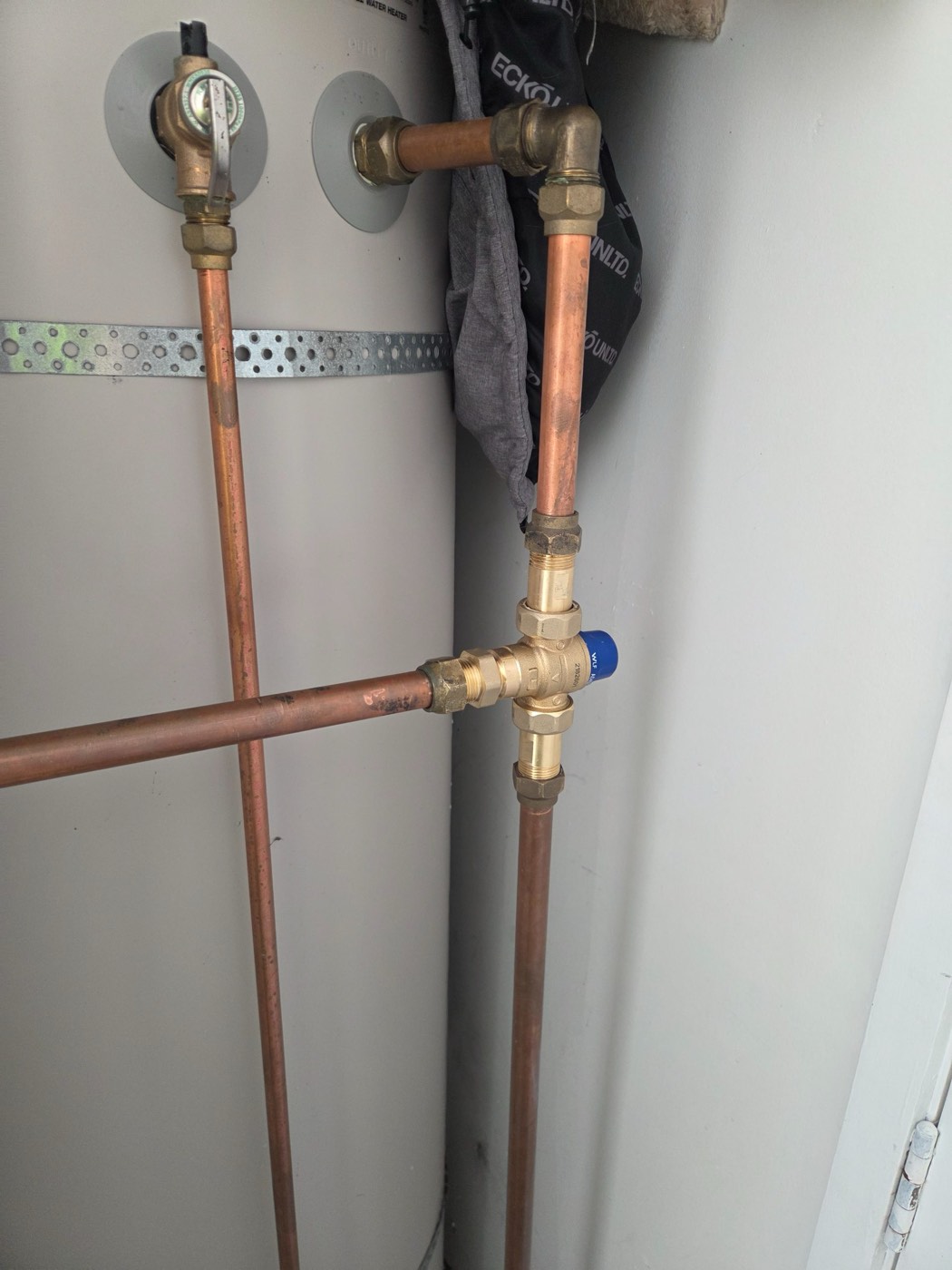
This is the one most people have never heard of. Your cylinder stores water at around 60°C on purpose — below that, bacteria survive in the stored water. But 60°C will scald a child in seconds, so the water is not allowed to leave the cylinder at storage temperature. A small brass valve on the pipework above the cylinder blends in cold and delivers water to your taps at a safe temperature.
When that valve fails, it almost always fails by letting in too much cold. The stored water is still 60°C. What arrives at the tap is 35°C. The cylinder is working perfectly and you would never know. Tempering valves are a wearing part with a service life of roughly five to seven years — less in a hard-working property — so on a cylinder installed a decade ago and never touched, the valve has outlived its design life.
One quick test separates the valve from most other things: a tempering valve sits upstream of the whole house, so when it fails every hot tap goes lukewarm at the same time. If the shower is disappointing and the kitchen tap still runs properly hot, the valve is fine and you’re looking at a shower mixer instead.
At a rental in Clendon Park the tenant reported three faults at once and the property manager understandably assumed the lukewarm water meant the cylinder. It was the tempering valve — replaced, temperature tested, done. At a Henderson property the valve was leaking, and the previous installer had made the connection with a hose tap adaptor sealed with silicone, which is not a plumbing fitting and not a joint. At a commercial site in Takanini we replaced six of them in one visit, all the same age and all failing within months of each other.
What to tell us when you ring
Four answers and we usually know what we’re bringing before we arrive, and whether you want us or an electrician:
- Cold, or warm but not hot?
- Every hot tap, or just one?
- How old is the cylinder, and is it mains or low pressure?
- Does it come right after a few hours, or is it the same all day? And has it been getting worse gradually, or did it change overnight?
Common questions
Is a hot water element or thermostat a plumber’s job or an electrician’s?
An electrician’s. The element and thermostat sit inside the cylinder’s electrical circuit, and replacing either is electrical work, not plumbing. What we can help with is everything around it — telling you whether the cylinder is worth putting a new element into, dealing with the pipework and valves, and replacing the cylinder if that’s where it lands. If you ring us with a stone cold cylinder we will say so honestly rather than sending someone out to look at it.
My cylinder is 15 years old and the water has gone cold. Repair or replace?
It depends on the type. At 15 years a mains pressure cylinder is already past the average, so putting a new element into it is a gamble — you are draining and re-pressurising an old tank to install a part you may lose when the tank goes. A low pressure cylinder at 15 years has a fair bit of life left on average, and an element replacement is usually money well spent. Tell us which you have and roughly how old it is and we will give you a straight answer, including when the answer is “don’t spend it yet.”
How long does a cylinder take to reheat?
Several hours for a full tank, depending on the element rating and how much you drew off. That is why hot water problems so often look worse in the evening than in the morning — the tank has had all night to recover and then gets emptied in an hour. If your water is fine at 7am and disappointing at 7pm, that timing is information, and it points at capacity rather than a broken part.
Can I just turn the tempering valve up myself?
Most domestic tempering valves have an adjustment, and we’d still ask you not to touch it. The valve exists to stop people being scalded, and the delivery temperatures it is set to are regulatory rather than a matter of preference. A valve that has failed by letting in too much cold usually can’t be adjusted back into range anyway — the internal element has worn, and turning the dial just moves a broken part around.
My water is scaldingly hot instead. Is that the same valve?
It can be. A tempering valve can fail in the other direction and pass water through at close to storage temperature, which is genuinely dangerous — 60°C water causes a serious burn in about a second, and faster on a child. If your hot taps have started running much hotter than they used to, treat it as urgent rather than a nice surprise, and be careful with the bath in the meantime.
Related reading
- Hot water cylinders: leaking, faulty, or due for replacement
- No hot water in Henderson, and the cylinder was not the problem
- Water under the hot water cylinder: four things it could be
- Common noises from a water heater
A tempering valve is a small part with a big effect on how the whole system feels. We cover Clendon Park and South Auckland, and our hot water service covers valves as well as cylinders. Call 021 837 775.