
Almost everyone who rings us about a water filter opens with the same question — which one should I buy? — and it is the second question, not the first.
The first one is where your water comes from. A house on Watercare town supply and a house on a rainwater tank have almost nothing in common on this subject. One is choosing a filter for taste. The other is treating water that has not been treated by anybody, and for them a filter is not optional.
So this is the guide in the order the decisions actually happen: what you are trying to fix, which type of system fixes it, and the part almost everyone underestimates — keeping it working afterwards.
Do I actually need a filter at all?
On Auckland town supply, no — not for safety. Watercare treats the water to the New Zealand drinking water standards before it reaches you, and it arrives at your boundary meeting them.
What people are usually reacting to is taste and smell, and the overwhelming majority of the time that is chlorine. Chlorine is in the water on purpose; it is what stops bacteria surviving the trip through the network to your house. It is also the faint swimming-pool note that some people never notice and others cannot ignore.
We had a customer in Mount Eden who had spent twenty-five years on tank water on a lifestyle block before moving into a city apartment, and the change in the water was a genuine shock to them. They were certain they were tasting fluoride. They were tasting chlorine — which matters, because one of those is easy to filter out and the other is not.
Two other reasons to filter are worth naming, because they are real and they are not about chlorine:
- Your own pipework. Water can leave the treatment plant meeting every standard and still pick up taste, sediment or metals from old pipe and old fittings inside your house. Low-lead requirements for tapware sold in New Zealand have been tightened in recent years, which is one reason very cheap imported tapware is a false economy.
- Sediment. Grit and rust in the water, often after works on the network nearby, is a different problem from chlorine and needs a different filter. If that is what is happening to you, start with brown or discoloured water.
And if you are on tank or bore water, everything above is beside the point. Skip to the rural section.
Under-sink, whole-house, or a jug?
Three categories, and they solve different problems.
| What it treats | Typically for | The catch | |
|---|---|---|---|
| Jug filter | The water you pour into it | Renters, one or two people, testing whether you care | Small volumes, short cartridge life, easy to forget |
| Under-sink | The cold water at one kitchen tap | Most Auckland houses on town supply | Drinking and cooking only — the rest of the house is unfiltered |
| Whole-house | Everything entering the house | Sediment, rural supply, showers and appliances too | Bigger install, bigger cartridges, needs a sensible location |
Most people asking us this question want the middle one. It is the standard fit in an Auckland kitchen, it is the cheapest of the plumbed options, and it puts the filtration exactly where the drinking water is.
What goes under the sink, in practice
The system we install most often is a Puretec PureMix inline cartridge — usually the Z6, which filters to 0.1 micron, or the Z7 at 1 micron. They mount inside the cabinet, feed off the cold line, and are designed to be changed with a quarter turn rather than a spanner.
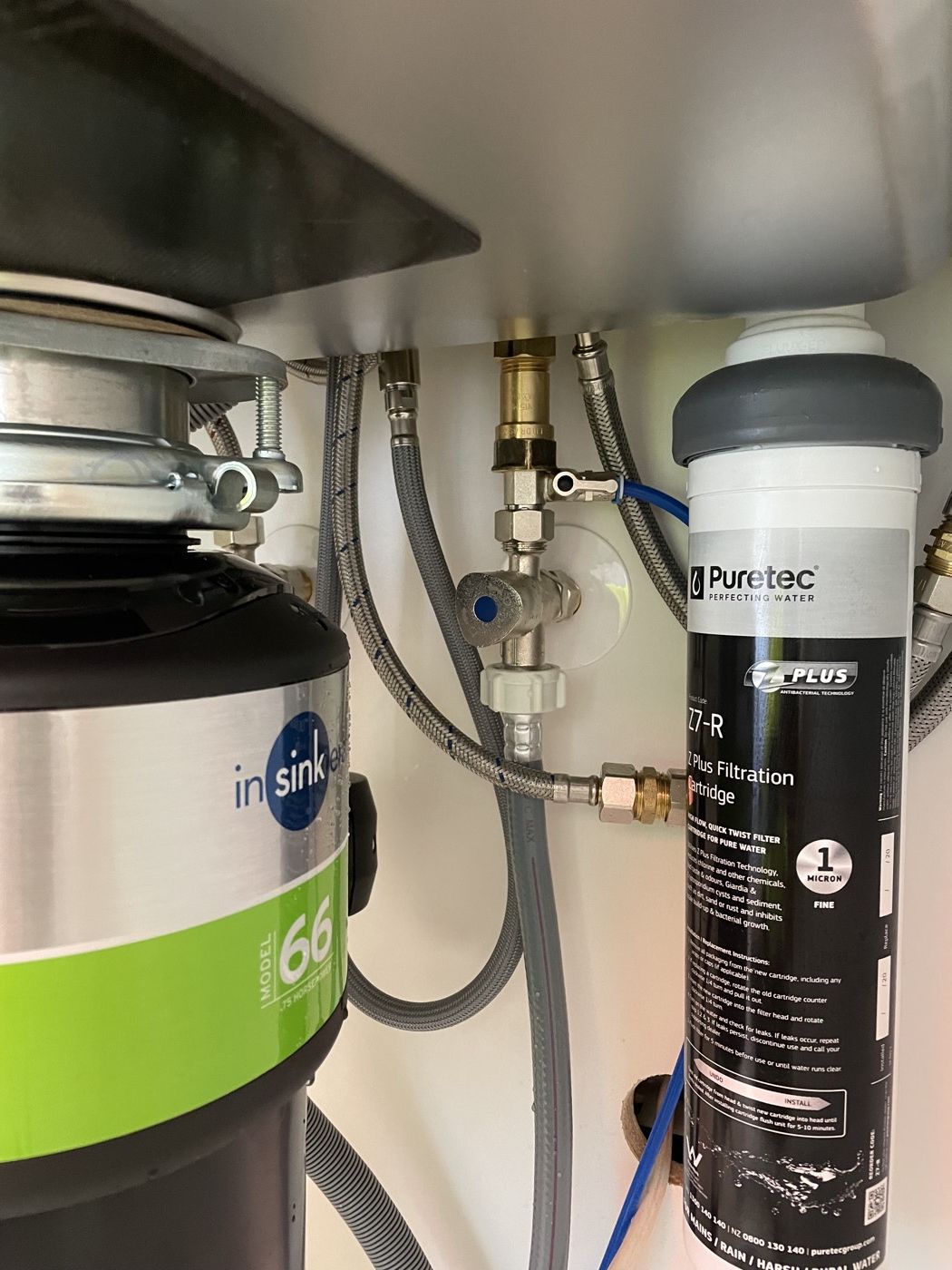
Two things decide which way we plumb it.
Inline, through the tap you already have. The filter goes into the cold feed of your main kitchen mixer, so every bit of cold water from that tap is filtered and there is no second tap on the bench. This is what most people choose now, because the kitchen stays uncluttered. The thing to understand is that it filters cold only — filtered hot water for cooking means boiling the filtered cold, or a separate boiling unit.
A dedicated filter tap. A small second tap beside the mixer, fed straight from the filter. It uses a cartridge that can be much more aggressive about taste, odour and heavy metals than you would want to run your whole cold supply through, and the filtered water is unmistakably separate from the rest.
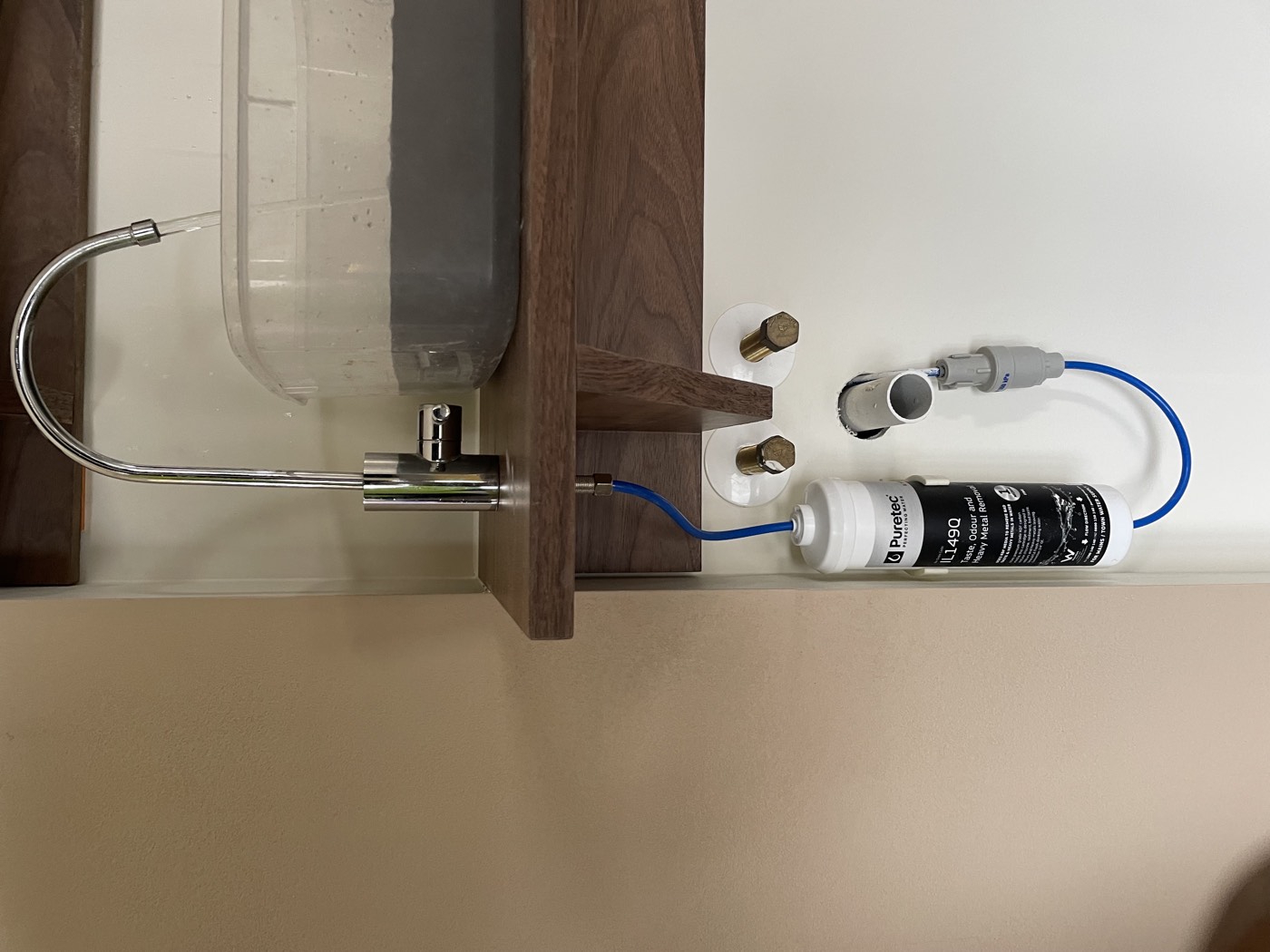
There are also “3-in-1” tapware options that put hot, cold and filtered through one spout, and boiling/chilled units that do a great deal more and need a great deal more room under the bench. If you are considering one of those, talk to us before you buy it, because the constraint is almost always cupboard space and the power point, not the plumbing.
The best moment to install any of this is during a kitchen renovation. A large share of the under-sink filters we fit go in as part of a kitchen job, at fit-off, when the cabinetry is being built around them and we can put the cartridge somewhere you can actually reach. Retro-fitting into a finished kitchen works, but you take the space you are given. Our kitchen renovation plumbing guide covers what to decide and when.
When does a whole-house filter make sense?
When the problem is not confined to the drinking water — sediment, grit, discolouration, or a supply that is not town treated.
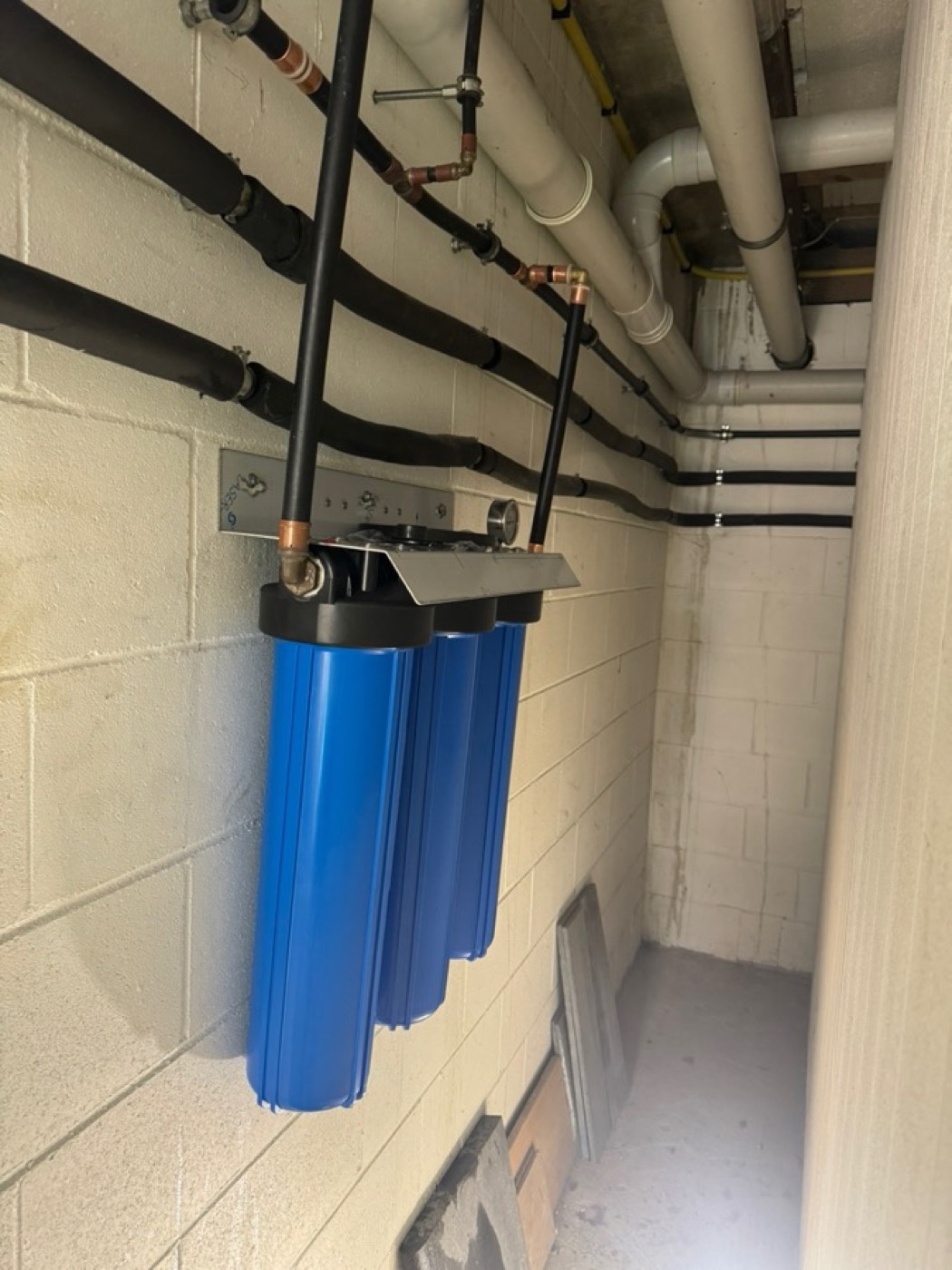
That is a triple 20-inch jumbo set we installed at a property in Saint Marys Bay, and its make-up is a good illustration of how these are actually put together. It is not one filter three times over. It is a sequence, each stage taking out what the next one cannot afford to be clogged by:
- 20 micron — the coarse stuff.
- 5 micron polyspun — finer sediment.
- 1 micron carbon — taste, odour, chlorine.
On a rural property at Karaka Road that had no filtration at all, the interesting part of the job was not the filter — it was where we put it. The pump was under the house, so we rerouted the water line to bring the three-stage system somewhere with real access. A filter you have to crawl to is a filter that does not get changed, and the cartridges are the whole point.
This is the one type of filter we will not quote over the phone. A whole-house system has to go on the main line as it enters the house, which means we first have to be able to find that line and get at it. In a house on piles with a subfloor, that is usually straightforward. In a house on a concrete slab, the main can be genuinely difficult to locate, because it comes up through the slab and everything before that point is buried — and where it surfaces is not always where you would expect. Sometimes the workable answer turns out to be outside the house entirely, near the water meter box or along the wall, rather than indoors.
So a whole-house filter always starts with a site visit. What we are deciding on that visit is not which filter — it is whether there is a point on your main where one can sensibly go, and whether you will be able to reach it twice a year for the rest of the time you own the house. Those two answers shape the quote far more than the model does.
Tank and bore water: a filter is not a steriliser
This is the distinction we are most careful to put in writing, because it is the one that matters.
A sediment-and-carbon filter removes dirt, particles and a good deal of what you would object to in rainwater. It does not guarantee the water is sterile, and it is not a defence against organisms like E. coli. That needs UV treatment or another form of disinfection, and it is a separate piece of equipment.
At a property on Dairy Flat Highway we inspected the tank, presented the options, and installed a twin-mount whole-house filter for the rainwater supply. We told the owner plainly, in the report, that the system chosen did not include a UV steriliser and would not guarantee sterilisation. The tenant then asked about adding one — and the property manager’s call was the right one: do a water test first, and let the result decide whether UV is needed, rather than buying equipment on a guess.
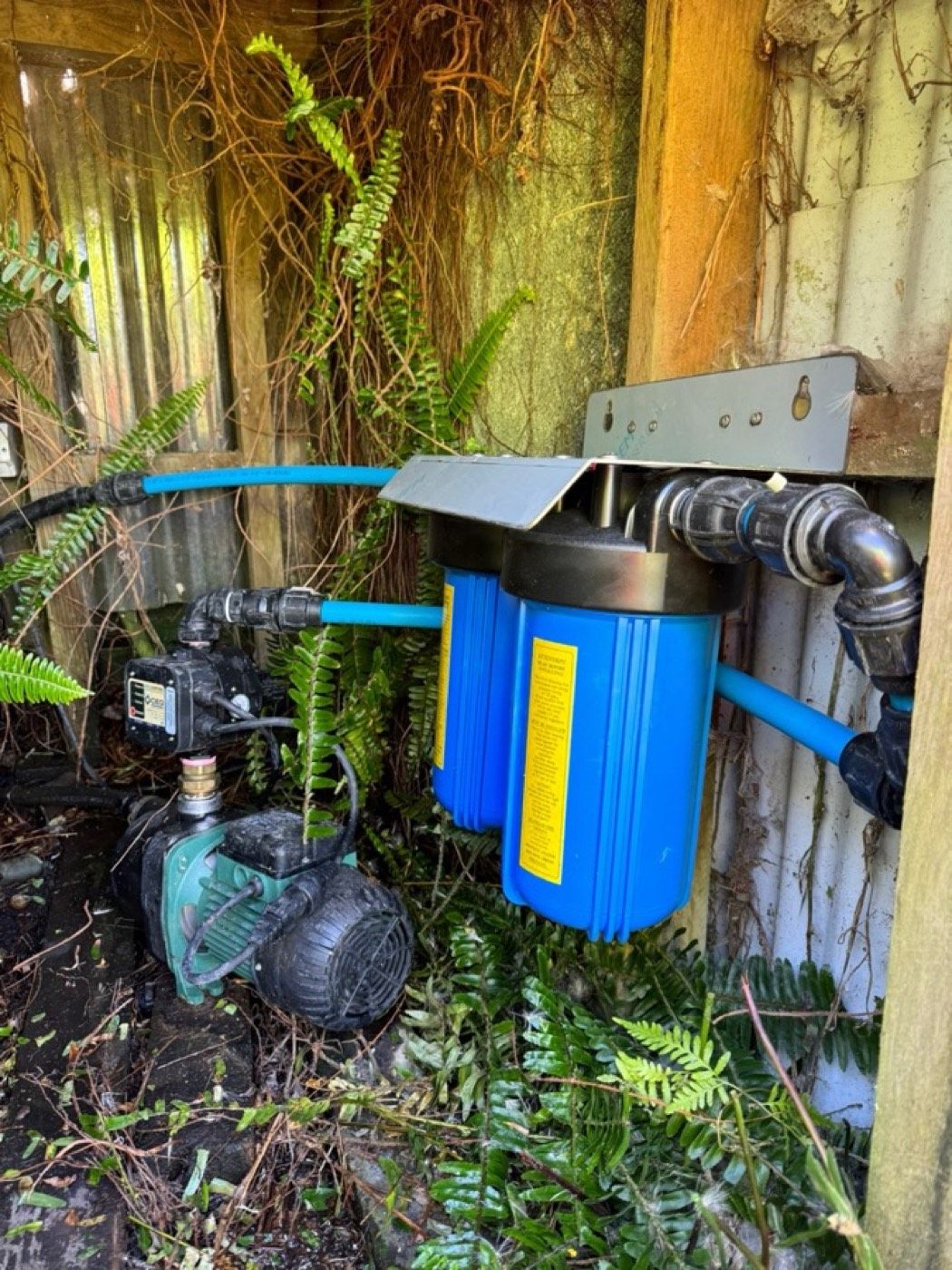
There is a second rural lesson, and it has nothing to do with drinking water. On a tank supply the filter is in the line that feeds the whole house, which means a neglected cartridge does not just stop filtering — it stops the water. A rural tenant at Normanby Road rang because there was no water at all. The pump filter was so badly clogged with debris it was unusable. They sent us a photo of the pump so we could bring the right cartridge, we swapped it, and the flow came straight back.
That is the fault we get called to on tank systems more than any other, and it is entirely preventable.
How often do cartridges need changing?
Every 6 to 12 months, depending on how much water goes through and how dirty it is. Cartridges are consumables, in the same way tyres are.
We installed the Saint Marys Bay jumbo triple set in August of one year and replaced the full set in August of the next. That is what the rhythm looks like when someone is doing it properly.
Two things to be clear about:
- An overdue cartridge is worse than no filter. It is a warm, wet bed of trapped organic material sitting in your drinking water line. Past its service life it stops being a barrier and starts being a source.
- A clogged cartridge restricts flow. If the water at one tap has gone weak and nothing else in the house has changed, the filter is the first thing to check — not the last. Other things cause that too; the common causes of low pressure runs through them.
Put a reminder in your phone on the day it is installed. Nobody remembers otherwise.
Can I change the cartridge myself?
For most modern under-sink systems, yes, and the manufacturers have deliberately designed them that way — quick-twist heads, no tools. There are usually clear replacement videos from the manufacturer, and the cartridges themselves are a standard size you can buy without going through a service agent.
The parts people get wrong:
- Isolate first. There is a small valve on the filter feed for exactly this purpose. Turn it off and release the pressure before you unscrew anything.
- Seat it properly. An imperfectly seated cartridge does not gush — it weeps, quietly, into the bottom of a closed cupboard. That is how you end up with swollen cabinetry and a floor to replace, and several manufacturers will not cover water damage caused by a DIY change.
- Flush it. Five to ten minutes, or until the water runs clear, before you drink any of it.
- Check it again the next day. A slow leak takes a while to show itself.
Whole-house jumbo housings are a bigger ask — they hold a lot of water, the housings can be stiff, and they are often in an awkward spot. Most owners have us do those.
What a filter will not fix
- Fluoride. Standard carbon cartridges do not remove it. Reducing fluoride meaningfully takes different technology, and it is worth understanding what you are actually tasting before you spend money on it.
- Water pressure. A filter can only reduce flow, never increase it. If pressure is the complaint, that is a different diagnosis.
- Hot water that smells or looks wrong. That points at the cylinder, not the supply, and a cold-line filter will do nothing for it.
- Brown water from a mains event. If Watercare has been working in your street, the fix is flushing and patience, not a purchase.
- Bad taste at every tap in the neighbourhood. Ring Watercare before you ring a plumber.
Common questions
Will a filter make my water pressure worse?
A clean cartridge has a small effect you are unlikely to notice on a normal Auckland mains supply. A clogged one has a large effect you will definitely notice. That difference is the whole argument for changing them on schedule.
Which is better, Z6 or Z7?
They are different, not ranked. The Z6 filters finer, to 0.1 micron. The Z7 is a 1 micron cartridge. Which suits you depends on what you are trying to remove and what flow you want at the tap — we will talk it through on site rather than guessing from a spec sheet.
Do I need a plumber, or can I buy one and fit it myself?
The cartridge change, mostly yourself. The original installation is a plumber’s job — it is a permanent connection into your drinking water supply, it needs an isolating valve, and it has to be done so that backflow is not possible. It is also the moment to put the unit somewhere that makes every future change easy.
We’re on a tank. What should I have?
At minimum, filtration before the pump or immediately after it, in a position you can reach. Whether you also need UV should be decided by a water test, not by a sales pitch. We are happy to do the filtration and tell you honestly where the limits of it are.
The filter tap water tastes odd after a cartridge change.
Normal for the first few minutes, and it means it was not flushed enough. Run it until it clears. If it is still wrong the next day, ring us.
Does a filter help with the pipes in an old house?
A point-of-use filter improves what comes out of that tap. It does nothing about what the pipe itself is doing. In a house with failing old pipework, that is a different conversation entirely.
Related reading
- Mount Eden: an under-sink filter for chlorine, not fluoride
- Fitting a whole-house filter, and why the garden tap goes before it
- Brown water from the tap: what it is and what to do first
- Kitchen renovation plumbing: what we do, when, and what you decide first
- Got low water pressure? The most common causes
- Water pressure in Auckland homes, and why it is highest at night
- What plumbers wish you’d stop putting down your kitchen sink
- Re-piping a house: when repairs have stopped being the answer
Thinking about a filter, or overdue for a cartridge change and not sure what you have? Send us a photo of what is under your sink and we will tell you what it is and what it takes. Call Nexus Plumbing or email admin@nexuspgd.com.
Filters only earn their keep when they match what is actually in your water. Supply and installation sit under our residential plumbing service. Call 021 837 775.