
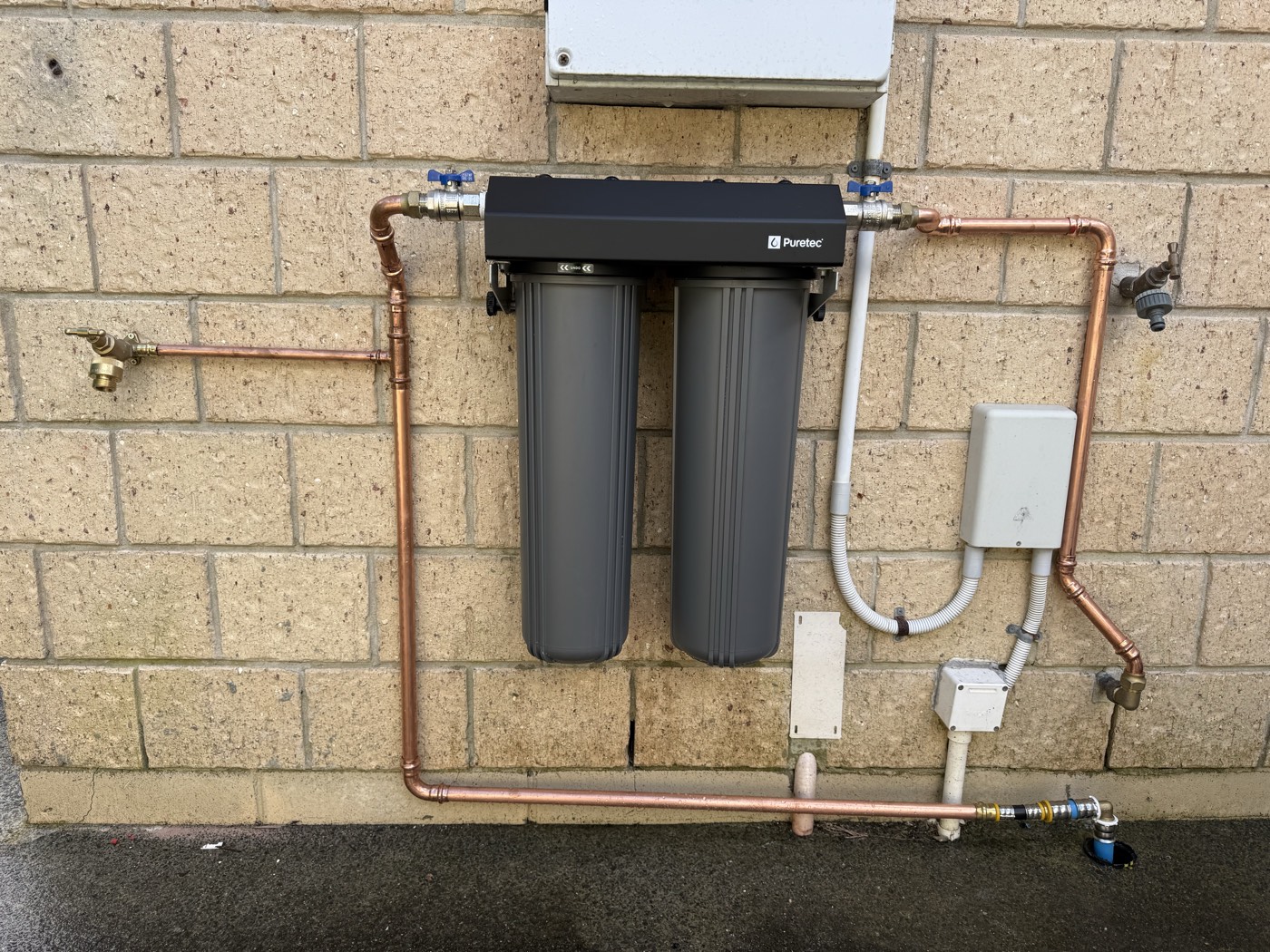
A household in Flat Bush had bought a twin-cartridge whole-house water filter and asked us to fit it while we were there finishing their new ensuite. The house is on a concrete slab, so there was no subfloor to work in. We mounted the filter on the outside wall, close to where the main comes up out of the ground, and ran the new pipework in copper. One request from the owners shaped the whole layout: they did not want the garden watered with filtered water. So we added a new outside tap on the supply side, before the filter.
That one decision is the part most people do not think about until after the filter is in.
Where does a whole-house filter actually go?
A whole-house filter is fitted on the main water line as it enters the house, before it splits off to the hot water cylinder, kitchen, bathrooms and laundry. Everything downstream of it gets filtered water.
In a house on piles, that point is often under the floor. In a house on a slab, the main usually comes up through the concrete or the ground outside, and everything before that is buried. Very often the most workable place is on an outside wall, near where the pipe surfaces or near the water meter box. That is what we did in Flat Bush.
Wherever it goes, it has to be somewhere you can reach. The cartridges need changing, and a filter that is hard to get to is a filter that gets forgotten.
Three installs, three different answers
No two of these go in the same way. Three recent ones show the range.
Flat Bush — twin cartridge, on the wall. The one above. A slab house, so the filter went on the outside wall near where the main surfaces, with copper pipework clipped to the brick, a valve on each side of the filter head, and a separate garden tap teed off before it.
Henderson — triple jumbo, on its own stand. The owners bought a three-housing 20-inch “Big Blue” style system on a freestanding frame, and set it up on the concrete beside the house, next to the meter board. Our job was to connect it into the main in 20mm copper. A frame like this is a good answer where the wall is crowded with other services or the cladding is not something you want to drill. The catch is that the frame has to be stable and level, because the housings are heavy when full and the pipe joints should never be what holds it up.
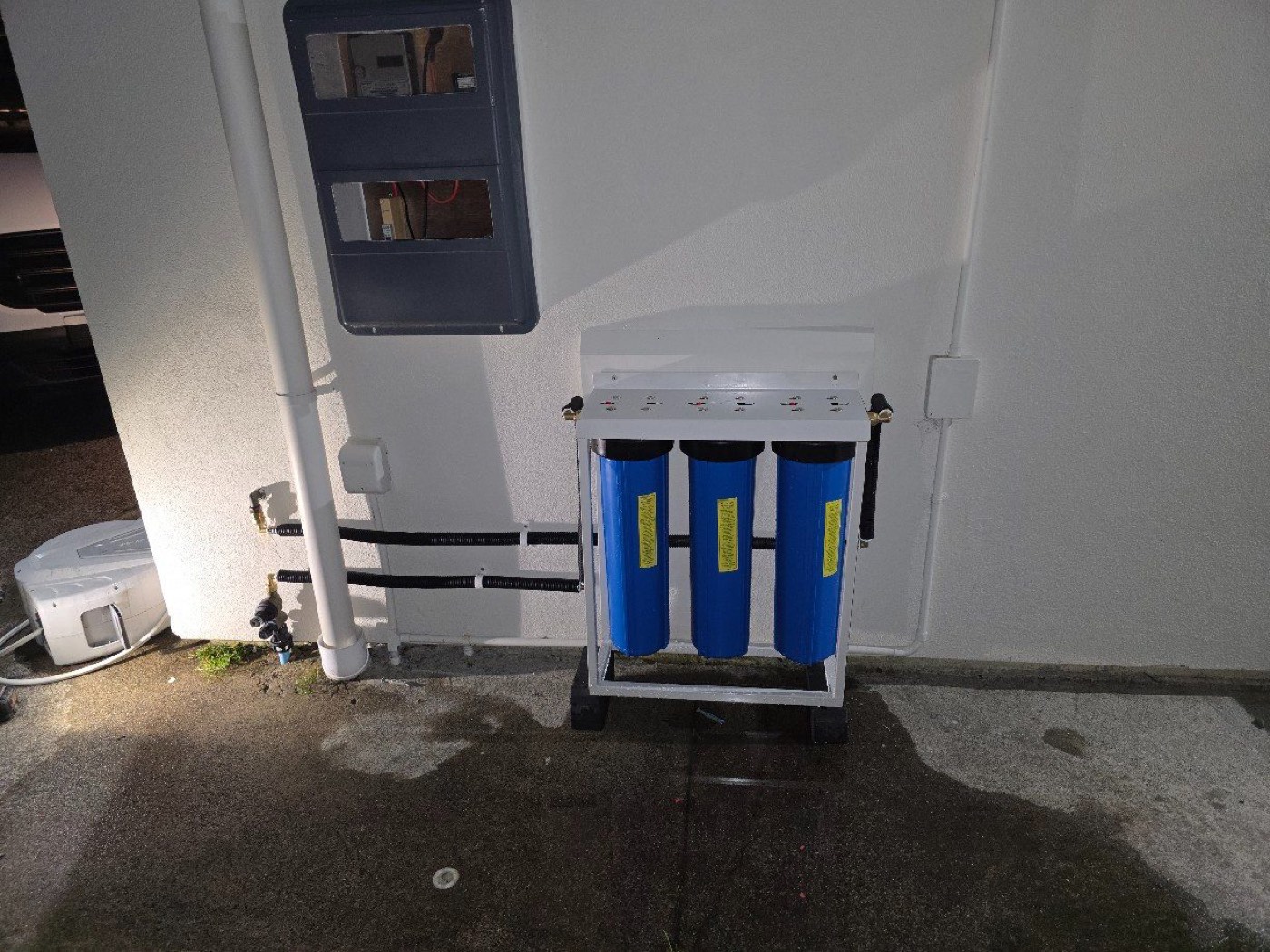
Saint Marys Bay — triple jumbo, and the first change a year later. Another three-stage 20-inch set, fitted to the main of a house in Saint Marys Bay. Twelve months on we went back and replaced the filter set. That return visit is the part people forget to budget for. A whole-house filter is not a one-off purchase; the cartridges are an ongoing cost, roughly once a year on town water.
What do the three stages in a jumbo filter do?
The Saint Marys Bay set is a typical example of how a three-stage system is built up:
- 20 micron sediment. Catches the coarse material: grit, rust flakes and anything stirred up when the mains are worked on.
- 5 micron polyspun sediment. Catches the finer particles the first stage let through.
- 1 micron carbon. Takes out chlorine taste and smell, and the finest particles.
The order matters. The cheap sediment cartridges protect the expensive carbon one, so it lasts longer and keeps working. Put the carbon first and it clogs with dirt it was never meant to deal with. A twin system like the Flat Bush one does the same job in two steps, usually sediment and then carbon.
Why put the garden tap before the filter?
Because the garden does not need filtered water, and the cartridges are what you pay for.
A whole-house filter treats every litre that passes through it. If the outside taps are downstream of it, every hose, sprinkler and car wash runs through your cartridges and wears them out faster. On a dry summer, garden watering can be a large share of a household’s water use.
Teeing off an outside tap before the filter means:
- Cartridges last longer, because only the water used inside the house passes through them.
- Garden pressure and flow are not limited by the filter.
- You still have water outside if the filter is ever isolated for a cartridge change or a repair.
In Flat Bush, the new garden tap was teed off the main before the filter. Water for the house goes through the filter. Water for the garden does not.
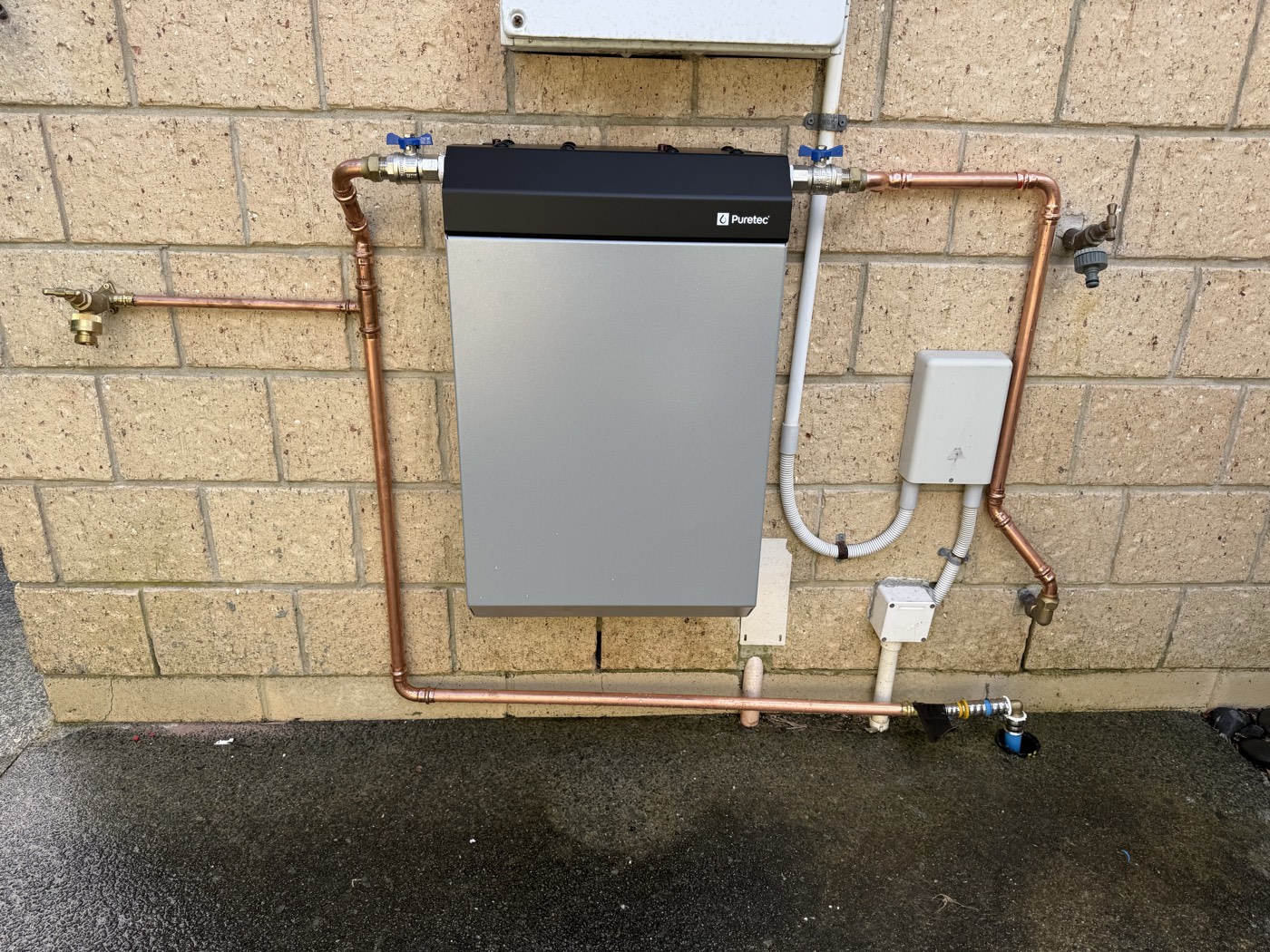
The Flat Bush filter finished, with its cover on. The tap on the left is fed before the filter, so the garden never runs through the cartridges.
What else should be in the installation?
A few details make the difference between a filter that is easy to live with and one that is a nuisance:
- An isolation valve on each side of the filter. Turn both off, and you can open the housings to change cartridges without shutting off water at the meter or draining the house. On this job both valves sit right at the filter head, so a change takes minutes.
- Neat, properly supported pipework. Copper clipped back to the wall will not move when valves are turned or housings are unscrewed. A filter hanging off flexible hoses will.
- Room underneath. Jumbo housings drop straight down to come off. If there is not enough clearance below them, every cartridge change becomes a fight.
- A leak test under full pressure before the job is signed off, and again after the first cartridge change.
Does a whole-house filter affect water pressure?
A clean cartridge has a small effect that you are unlikely to notice on a normal Auckland mains supply. A clogged cartridge has a large effect that you will notice, usually as weak showers first. If pressure drops slowly over a few months after a filter goes in, that is normally the cartridges telling you they are due, not a fault with the installation. For more on pressure, see water pressure in Auckland homes.
Do I need a plumber to fit one?
Yes. A whole-house filter goes on the mains supply to the house, which is plumbing work that has to be done by a licensed plumber. It means cutting into the main, fitting valves and making joints that will sit at full mains pressure for years. Buying the filter yourself is fine. Many owners do, as both the Flat Bush and Henderson households did, and we fit it. If you are choosing one, our guide to choosing a water filter in New Zealand covers whole-house versus under-sink and what different cartridges remove.
Common questions
How often do whole-house filter cartridges need changing?
It depends on the cartridges, your water and how much you use, but on Auckland town water most households change them every six to twelve months. The manufacturer’s rating is a starting point, not a rule. Falling pressure, or a change in taste or smell, are the practical signs. Keeping the garden off the filter, as in this job, stretches the interval.
Will a whole-house filter remove fluoride?
Usually not. Most whole-house cartridges are sediment and carbon, which deal with dirt, rust particles, chlorine taste and smell. Fluoride needs a specific type of filter, usually fitted under the sink for drinking water only. We explain the difference in this Mount Eden job.
Can a whole-house filter go outside?
Yes, and on slab houses it often has to. Choose a spot out of direct sun if you can, because sunlight can encourage algae in clear housings and weathers the plastic. Opaque housings or a cover help. The filter should also be somewhere that will not get knocked by cars, bins or mowers.
Should the hot water cylinder be after the filter?
Normally yes. A whole-house filter sits before the cylinder, so the hot water is filtered too. That also means less sediment settling in the bottom of the cylinder over time. The exception is if your filter has a specific flow or temperature limit that does not suit your system, which is worth checking before you buy.
What if I already have a filter and the outside taps run through it?
It can usually be changed. A plumber can add a new tap, or re-route an existing one, from a point on the main before the filter. It is often a small job, and it pays for itself in cartridges if you use a lot of water outside.
Related reading
- Choosing a water filter in New Zealand
- Mount Eden: an under-sink filter for chlorine, not fluoride
- Brown water from the tap: what it is and what to do first
- Where is my water meter box?
A whole-house filter is only as good as where it sits and how easy it is to service. We install them across Auckland, from Flat Bush to Henderson and the central city. Call 021 837 775.