
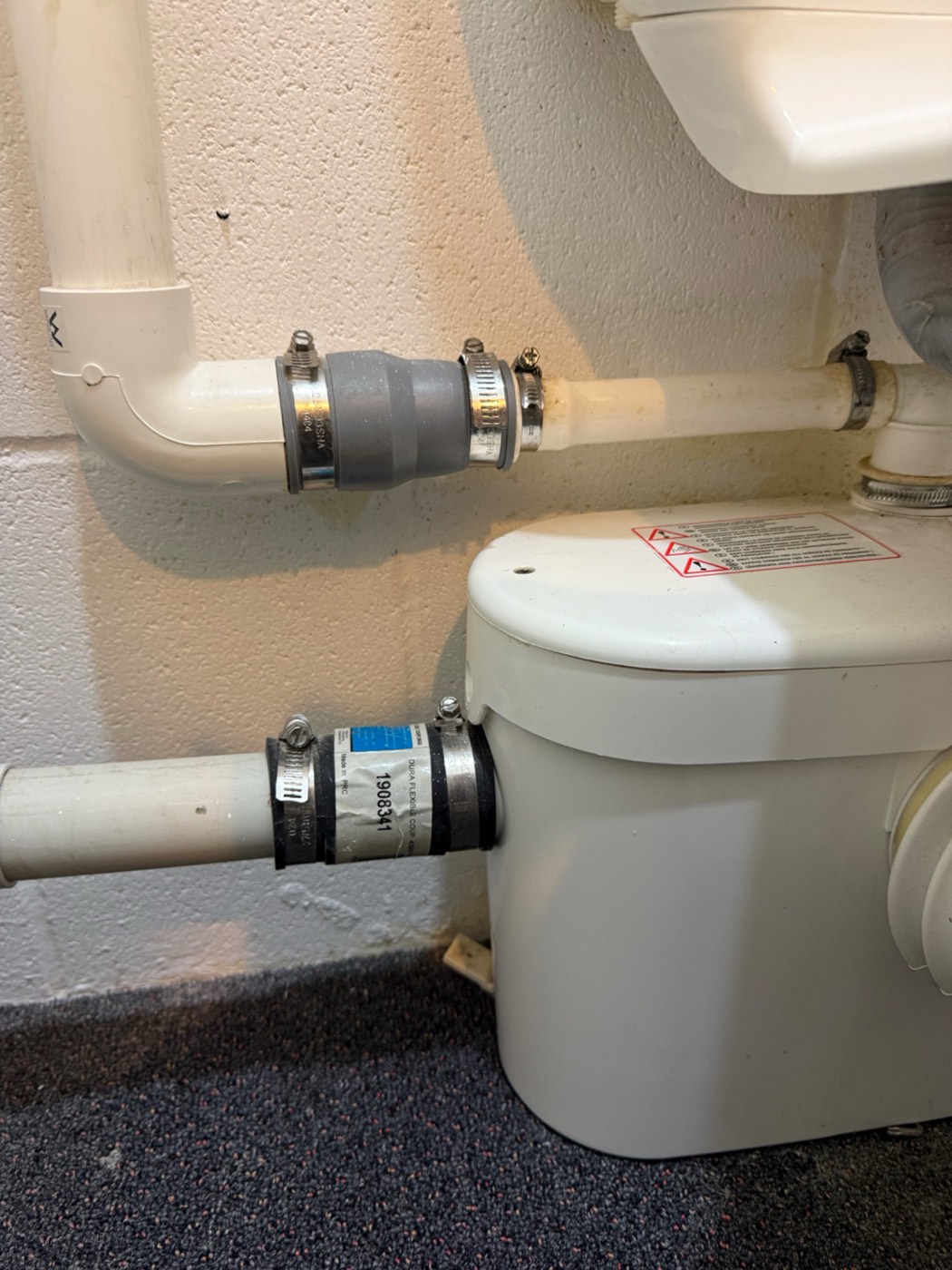
A homeowner in Point Chevalier has a toilet that runs through a Saniflo macerator pump. Nothing was wrong with it. It flushed, it pumped away, it stopped. We had been in the house for other work, and the owner asked if we could look after the pump before it gave trouble, rather than after.
So we did a straight maintenance visit. We checked how the unit started and stopped, opened it up, vacuumed out what had settled inside, cleaned the internals, and put a full dose of Saniflo’s own descaler through the system. After testing it again, the pump was running as it should and no parts were needed. The owner left the descaler to work for two hours, switched the power back on and flushed twice to rinse it through. It took one short visit, and we put a reminder in to come back the following year.
That is the whole story, and it is deliberately a boring one. The jobs we would rather not do are the other kind.
What is a Saniflo, and why does it need looking after?
A Saniflo (and similar brands such as Sanipro, Sanicubic, Hyundai and GreenLeaf) is a small pump that sits behind or beside a toilet, shower or basin where there is no gravity fall to the sewer. It grinds the waste with a spinning blade and pumps it up and away through a narrow pipe. That lets you put a toilet in a basement, a garage conversion or under a stair.
A normal toilet has no moving parts in the waste path. A macerator has a motor, a blade, a pressure switch that tells it when to start, and a one way valve that stops the pumped waste falling back. All of those sit in waste water every day. Auckland water is not especially hard, but scale still forms on anything that stays wet, and soap, paper fibre and hair stick to it. None of this is a fault. It is just what happens inside the box, slowly, whether anyone looks or not.
Why do macerators seem to fail all at once?
Because the build up is invisible until it crosses a line. The pressure switch that starts the pump works off a small chamber and membrane. As scale and debris coat it, the switch gets slower and less reliable. The pump might run a few seconds longer than it used to, or start up by itself in the night. Most people do not notice, or they notice and get used to it.
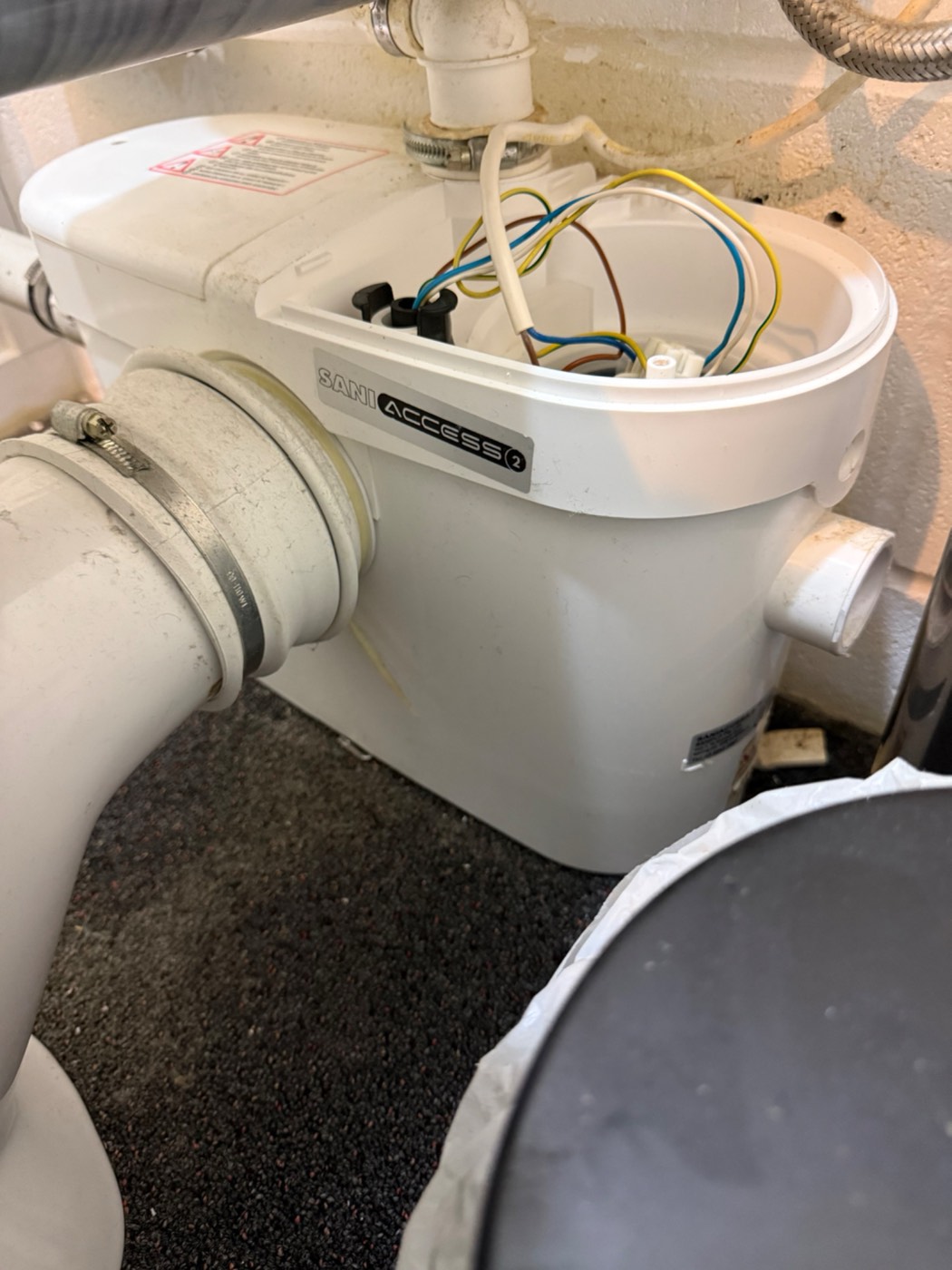
Then one day the switch sticks, or the blade jams on something that has been sitting there for months, and the toilet stops working entirely. Usually at the worst moment. We attended a Blockhouse Bay rental just before Christmas where the tenant had been without the use of the bathroom over a weekend. When we opened the unit, the history of earlier blockages was plain to see, and water had worked its way into the circuit board. By then it was a replacement, not a clean.
What does a yearly Saniflo service involve?
On a maintenance visit we work through the same order every time.
- Watch it run. A flush should start the pump straight away and it should stop within about 10 to 20 seconds. We listen for grinding, humming without pumping, or a pump that keeps going.
- Check it is not cycling on its own. If the pump starts when nobody has used anything, water is getting in from somewhere, usually a cistern or tap slowly passing water, or the one way valve letting pumped waste run back.
- Power off and open it up. Clear anything wrapped around or caught near the blade, and vacuum out the sediment in the bottom of the tank.
- Clean the pressure switch and the non return valve. These are the two parts that cause most call outs, and both respond well to a clean before they fail.
- Descale with the dedicated product. We use Saniflo’s own descaler, made for these units, not a general bathroom descaler. A full dose goes in with the power off and stays there for about two hours, then a couple of flushes rinse it out.
- Check the connections. Pan connector, inlet and discharge pipework, looking for weeping joints before they become a leak under the floor.
If we find something worn, you hear about it on the day, with a photo, rather than as an emergency later.
Why use Saniflo’s own descaler?
The inside of a macerator is not like a toilet pan. There are rubber seals, a flexible membrane on the pressure switch, a motor housing and plastic parts, all sitting in whatever you pour in. Strong acids, bleach, caustic drain cleaners and hardware store descalers are made for porcelain and metal pipes, and they can harden or crack those parts. That can turn a maintenance job into a replacement.
Saniflo’s descaler is formulated for the materials inside the unit, and it is also safe for septic systems. It is the product the manufacturer tells you to use, and it is the only one we put through a pump. If a pump fails and the wrong chemical has been used in it, a warranty claim can become a difficult conversation.
Can I just pour in descaler myself?
You can, and it helps, as long as it is the dedicated product. Unplug the unit, pour the descaler into the toilet bowl, leave it for no more than about two hours, then plug it back in and flush twice. Do not leave it overnight. Longer contact can damage the seals, and most manufacturers set two hours as the limit.
What descaler cannot do is remove a cotton bud from the blade, clean a membrane that is coated in debris, or tell you that the discharge joint is starting to weep. That is the part of the service that actually prevents the sudden stop. Descaling on your own between our visits is fine. Descaling instead of a service leaves the likely failure points untouched.
When is it repair and when is it replace?
Many problems are cleared on the spot: a jammed blade, a sticky pressure switch, a valve full of debris. The pump carries on for years.
Replacement comes up when the motor or the circuit board has failed, or when parts are no longer available. On a Takanini job the unit was leaking from its own fittings and no compatible fittings could be sourced, so a new pump was the only real fix. In Glenfield an owner replaced a unit that was only three to five years old. A pump that is serviced regularly tends to last much longer than that.
Common questions
How often should a Saniflo be serviced?
Once a year suits most homes in Auckland. A unit that also takes a shower or basin, or one in a busy household or rental, can benefit from a check every six months. If the pump has started running longer, making more noise or starting on its own, do not wait for the anniversary.
What should never go into a macerator toilet?
Only toilet paper and human waste. Wipes, including the ones labelled flushable, sanitary items, cotton buds, dental floss, paper towels, fats and oils all jam the blade or wrap around it. Hair is a problem on units that also take a shower. A small bin in the bathroom and a clear sign for guests or tenants prevents most breakdowns we see.
My Saniflo keeps turning on by itself. Is it broken?
Not necessarily. The pump is reacting to water arriving. Check the toilet cistern and any connected tap for a slow run into the bowl or basin. If nothing is passing water, the non return valve is the usual suspect, letting waste in the discharge pipe fall back so the pump has to move it again. A clean often fixes it, and the part is inexpensive to replace if not.
There is a red warning light and the pump is noisy. What should I do?
Stop using the toilet and anything else connected to the unit, and switch off the power at the plug. A warning light usually means high water level or a fault the pump cannot clear. Running it repeatedly can burn out the motor or push water where it should not go. Call a plumber who works on macerators, and tell them the brand and model on the label if you can see it.
Can you service a Saniflo in a rental property?
Yes, and it is one of the better maintenance jobs a landlord can book. A failed macerator can leave a tenant without a working toilet, which is an urgent repair. We regularly handle these through property managers, and we can arrange access with the tenant, leave written aftercare instructions on site, and send a short report with photos.
Related reading
- Toilet replacement in Auckland: what to expect
- That drip, drip, drip: your guide to fixing a leaking toilet
- Blocked drains in Auckland: causes and fixes
- Bathroom renovation plumbing in Auckland
- A plumber’s guide for property managers
We service Saniflo and other macerator pumps across Point Chevalier and the rest of Auckland, and we can remind you when your next service is due. See our residential plumbing services or call 021 837 775.