
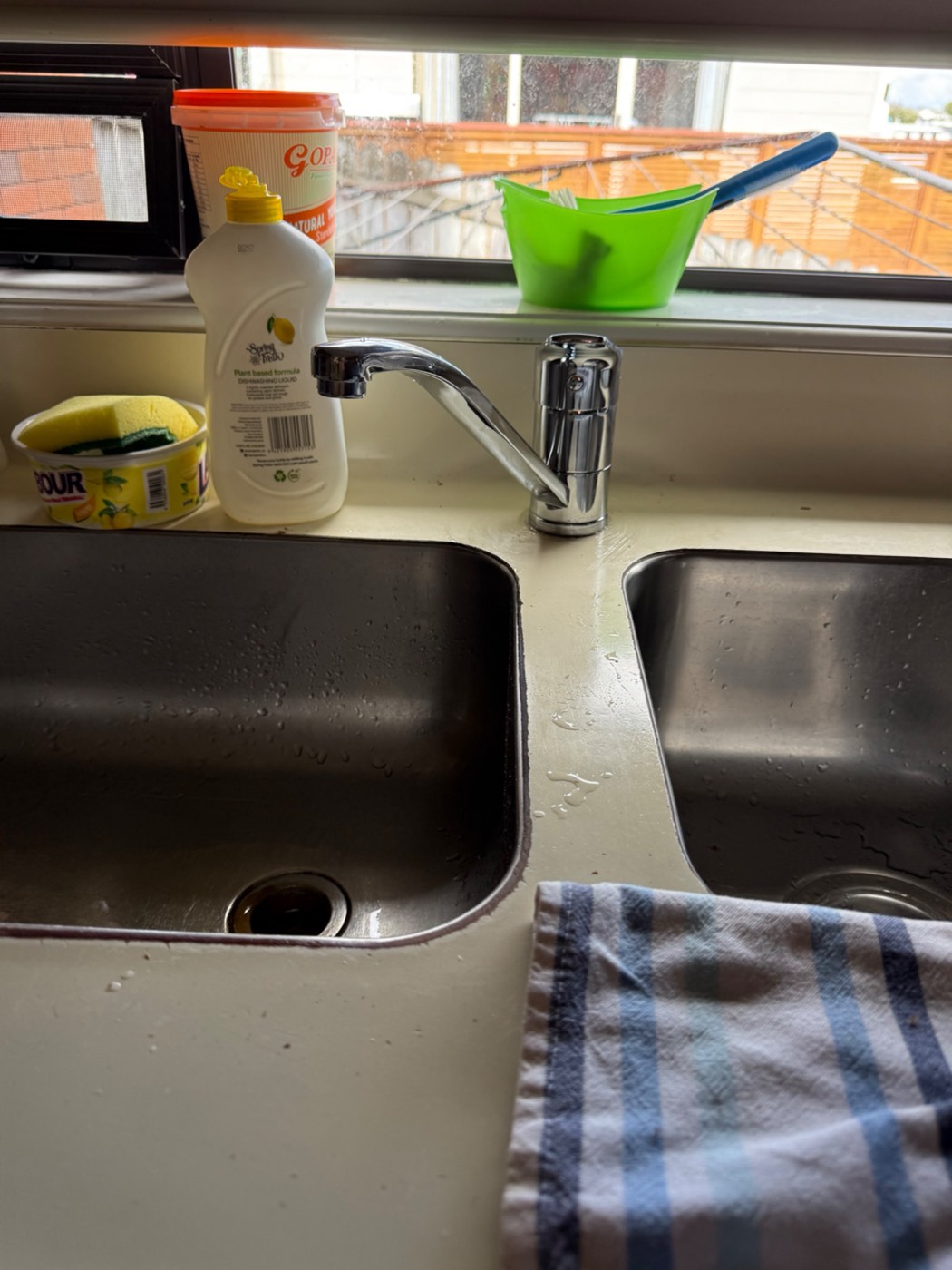
A property manager sent us to a Māngere East rental for a kitchen mixer that had started leaking. The tenant had been putting a container under it.
The leak was coming out of the tap body itself, not from the spout, not from the hoses underneath. That is the one answer nobody wants, because a body leak is the end of a tap. There is no seal to change and no cartridge that fixes it. We took it off and put a new one on.
The interesting part of that job was not the leak. It was what we had to check before ordering the replacement.
Where is it actually leaking from?
Four different faults get described as “the tap is leaking”, and they are not the same job.
From the spout, when the tap is off. Water drips out the end. That is the cartridge or, on older taps with two handles, the washer and seat. Whether that is repairable comes down to one thing: can the cartridge for that tap still be bought here. More on that below.
From under the handle, when the tap is running. Water seeps out around the base of the lever. Usually the cartridge again, sometimes the O rings in the tap body.
From the base of the spout, where it swivels. Water runs down onto the bench when you swing the spout. That is the spout O rings, which are a cheap part on a decent tap.
From the body of the tap. Water appears from the casting itself, or from a split. That is the end of it. Brass and cast alloy fail at stress points, and once the body is weeping there is nothing to reseal.
Then there is the fifth one, which is not the tap at all.
Sometimes the water is coming up through the bench
We went to a house in Unsworth Heights for the same complaint, a leaking kitchen tap. The tap was fine. There was a small gap between the sink top and the tap hole, and water from normal use was seeping through the hole into the cupboard below.
The reason it had started was that the tap hole had never been drilled cleanly, and the sink top was thin stainless steel. There is not much for the mounting to grip against, so the tap works loose a little at a time. We sealed the gap, and told the owners honestly that this is a limitation of that sink rather than something a new tap fixes.
If you find water in the cabinet and the tap itself looks dry, feel around the base of the tap while somebody runs it. That is a very different job from a failed cartridge.
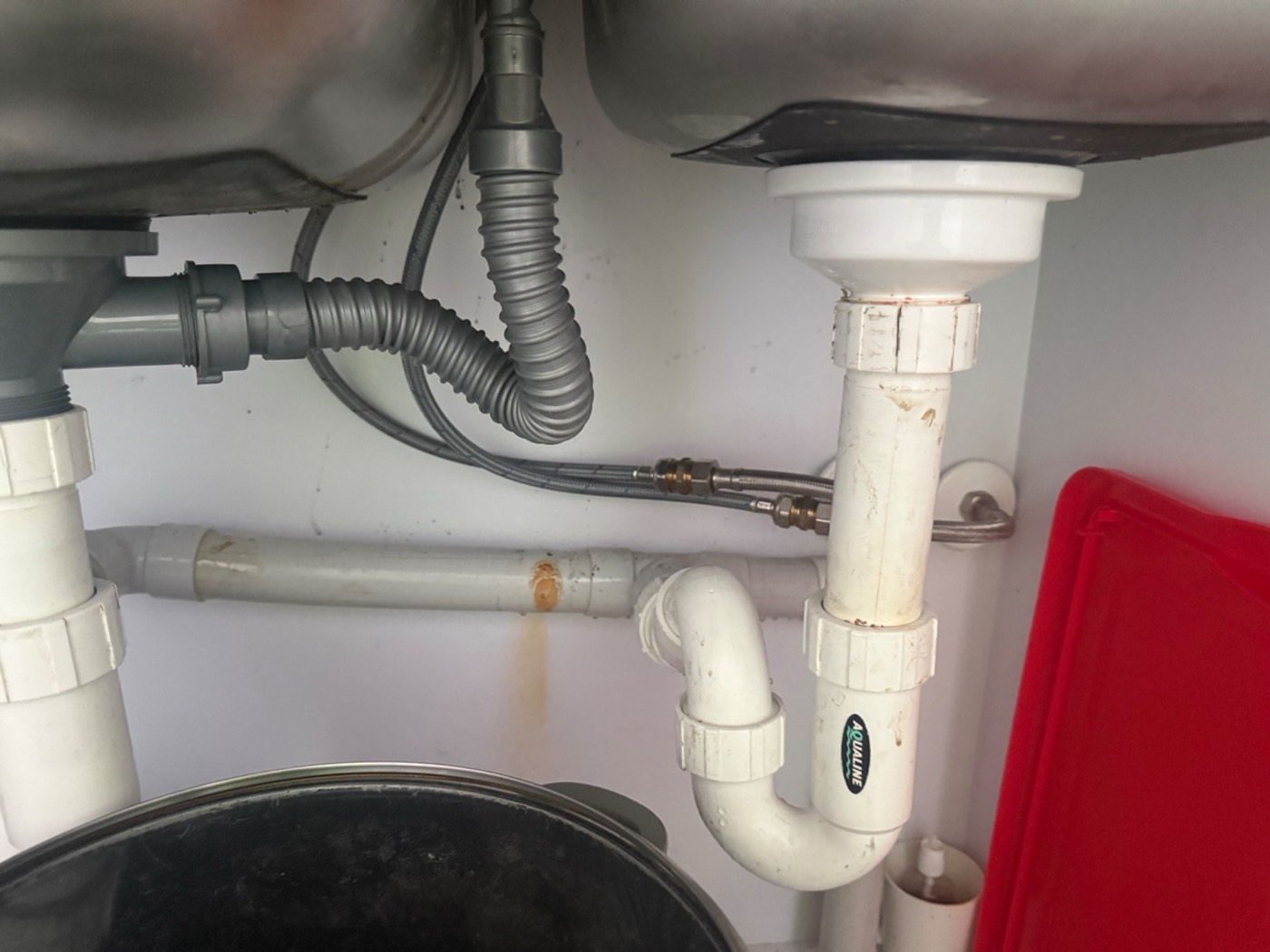
The bit that decides the replacement
Back in Māngere East. Before we ordered anything, we checked the hot water system, and the house is on a low pressure cylinder.
That matters more than the brand or the finish. In a low pressure house the hot side is gravity fed while the cold is still on the street main, so the two sides arrive at very different pressures. A mains pressure only mixer fitted to that house gives you a hot side that barely runs, and cold water pushing back through the cartridge when you ask for a mix. The customer would have rung us back in a week, and they would have been right to.
We fitted an all pressure mixer, which is the class that works on both systems, and set it for the house on the day. There is more on how to tell which system you have in our guide to choosing a tap or mixer.
Is it worth repairing?
The question that decides it is not how the tap looks. It is whether the cartridge for that exact tap can still be bought in New Zealand.
If it is a recognised brand, it usually can. There is a New Zealand agent, the cartridge is a stocked part, and a repair is possible.
If it is a no name tap, usually it cannot. Cartridges are not standard between brands. If nobody here stocks the one that fits, there is no repair to do, and the whole tap comes off.
So the first thing we do is identify the tap. What we will normally recommend after that, and we would rather say it up front, is replacement:
- Getting the right cartridge is rarely one visit. It has to be identified, ordered and fitted, so you are paying a call out twice. A replacement mixer is one visit.
- The rest of the tap is the same age as the part that failed. O rings, the spout seals and the seat have done the same years of work. Changing one of them buys you time, not a working tap.
- The labour is close to the same either way. Most of the cost of either job is having a plumber at your bench.
- A new tap starts a new warranty. A repaired old one does not.
Where we would repair rather than replace: a good quality tap that is not old, a high end mixer where the body is worth keeping, or tapware that matches the rest of a kitchen and cannot be bought any more. Ask us and we will tell you which one yours is.
The rest is simpler:
- Leaking from the body or a split anywhere. Replace it. Every time, regardless of brand.
- Tap moving in the benchtop. Sometimes a retighten from underneath. Sometimes the mounting has nothing solid to pull against, as above.
- Two handle tap, both sides dripping. Replace, because you are paying for the labour either way and you get a mixer out of it.
All of which is the argument for buying a tap with a New Zealand agent behind it in the first place. It is what makes a repair an option at all.
While you are waiting for us
Turn the isolating valves under the sink off, which are the small quarter turn taps on the flexible hoses. If there are none, that is worth fixing at the same time, since it means the whole house has to be shut down for any work on that tap.
Then dry the cabinet base out and keep it dry. The chipboard under a sink swells once it is wet and it does not come back. Most of the damage we see from a leaking tap is not the water, it is the cupboard.
If you want a straight answer before anyone comes out, text us a photo of the tap and of what it looks like underneath, or give us a call. We work across Auckland.
Common questions
Can a leaking kitchen mixer be repaired, or does it need replacing?
It depends where it leaks and what the tap is. A drip from the spout end or a seep around the handle is usually the cartridge, and a cartridge can only be changed if that exact part is still sold in New Zealand, which is a brand question. Water from the body of the tap, or any split in the casting, cannot be resealed at all. Even where a repair is possible we will usually recommend replacing the mixer, because sourcing the part means a second visit and the rest of the tap is the same age as the bit that failed.
How much of the job is the tap and how much is the labour?
On a straightforward swap, most of the cost is the visit rather than the tap, which is why fitting a very cheap mixer is rarely the saving it looks like. If it fails in two years you pay the labour again, and on a no name tap there is often no cartridge available, so the whole tap comes off.
Why did my new tap have such weak hot water?
Almost always because it is a mains pressure tap on a low pressure hot water system. The hot side of that house is gravity fed and the narrow waterways in a mains pressure mixer need pressure behind them. An all pressure mixer is the fix, and it is what we fit by default when the house is low pressure.
There is water in the cupboard but the tap looks dry. What else could it be?
Run the tap and feel around the base of it where it meets the bench, then check the flexible supply hoses, the waste trap and the dishwasher connection. Water travels along pipework before it drips, so the wet spot is often not above the fault. A gap at the tap hole is a common one and it looks nothing like a tap fault.
Should I turn the water off at the main?
Not usually. Look under the sink for small quarter turn valves on the two flexible hoses and close those, which isolates the tap only. If the tap has no isolating valves, you will need the main, and it is worth having valves fitted while the plumber is there.
Related reading
- Choosing a tap or mixer in a New Zealand home
- Castor Bay: water under the sink in a nearly-new kitchen
- Water under the sink: working out which pipe it is
- Flexi hoses: the quiet cause of most household water damage
- Kitchen renovation plumbing: what we do, when, and what you decide first
Whether a tap is worth repairing usually comes down to the cartridge and the age of the body. We work across Mangere and South Auckland. Call 021 837 775, or text a photo of the tap and we will tell you which it is. Tap and fixture work sits under our residential plumbing service.