
Water in the bottom of the cabinet is one of the most common calls we get, and it is also one of the few where five minutes of looking tells you most of what a plumber needs to know.
There are two completely different plumbing systems under there. Which one is leaking changes the urgency, the repair and the cost, and you can usually work it out yourself.
Is the water clean or dirty, and when does it appear?
Start here, because these two questions split the problem in half.
Clean water, wet all the time. That is the supply side, the pipes bringing water in under mains pressure. It never stops, so it will keep going while you are at work and while you are asleep. This is the urgent one.
Dirty or greasy water, only wet after you run the tap or empty the sink. That is the waste side, which only carries water when something drains into it. It is not under pressure, so it stops on its own between uses. Less urgent, but it will rot the cabinet floor if it is left.
If you are not sure, dry everything out completely, then do not use that sink for a few hours. Water back again with nothing used means supply. Dry until you run the tap means waste.
What is actually under there?
More than most people realise, which is why “the sink is leaking” covers a dozen different repairs.
On the supply side: two small isolating valves, the flexible hoses or tails running up to the tap, and often a filter or a boiling water unit spliced into the cold line. On the waste side: the sink outlet, the trap, the pipe running into the wall or floor, and usually a dishwasher hose and sometimes a waste disposer connected into it.
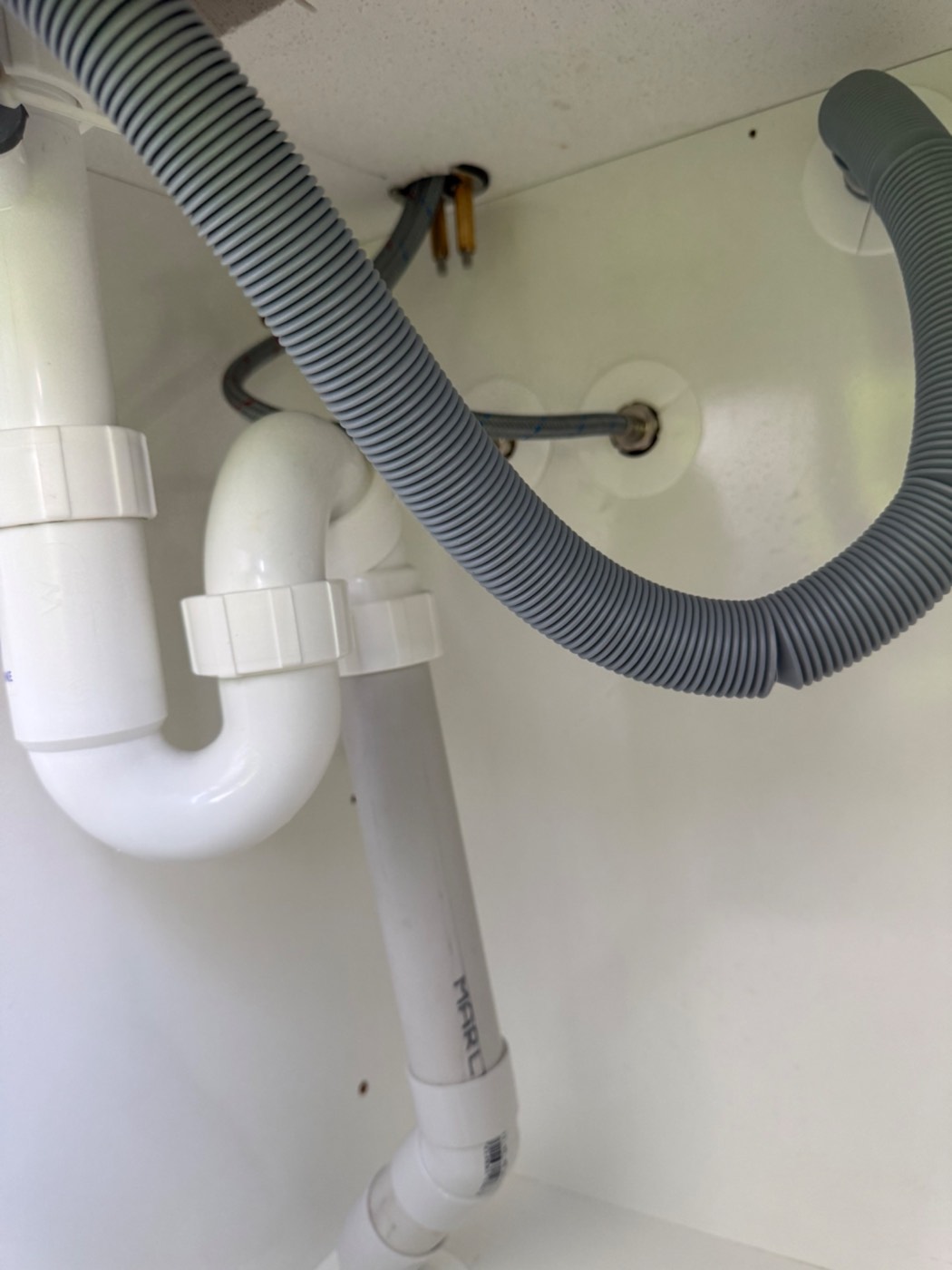
How do I find which connection it is?
Use the trick we put on our own kitchen invoices: dry paper towel.
Dry the whole cabinet out. Then wrap or tuck a piece of dry paper towel around each connection in turn, the two isolating valves, both tap tails, the trap joints, the waste into the wall, the dishwasher hose. Leave it, use the sink normally, and come back. The towel that is wet tells you where the water is coming from, and it works far better than trying to spot a drip in a dark cupboard with a torch.
Two things worth doing at the same time. Fill the sink right up and then let it out in one go, because a waste joint that is fine with a trickle will often show up under a full bowl. And run the dishwasher through a cycle, since dishwasher hoses only leak while they are pumping.
Send us a photo of the wet towel and the connection it was on. That is genuinely useful information and it is free to give us.
It is the tap itself. Now what?
This happens more than you would think, and it is the one answer people are not expecting.
We were called to a property in Birkenhead where a basin mixer was leaking. The body of the mixer had split, so there was nothing to tighten or reseal. We capped it off that day to stop the water, and came back to fit a new mixer once the client confirmed. A split body is not repairable.
The same goes for the flexible tails on most modern kitchen and basin mixers. They are crimped into the tap at the factory and not sold separately, so a leak there means new tapware rather than a new hose. There is more on how to tell the two apart in our guide to flexi hoses.
Can a blockage cause a leak?
Yes, and it catches people out because the symptom looks like a broken pipe.
When the waste blocks, water backs up and finds the weakest joint. Fix the joint and it will leak again the next time it blocks, because the joint was never really the problem.
We attended a basin in Glen Eden twice. The first visit cleared a blockage. A few months later it blocked again, and when we pulled the waste and trap apart there was a very large build up of hair and debris that had accumulated all over again. Nothing was wrong with the plumbing. The fix there was not a part, it was to stop washing hair over that basin.
If your sink is slow as well as wet, deal with the blockage first and see whether the leak goes away with it.
It only started after new work was done
Tell us, and we will come back.
We put a note on every kitchen installation invoice saying there is a small chance of a minor leak appearing later, because a waste disposer or a dishwasher moves slightly in use and a connection that tested dry on the day can weep once it is being knocked about. It is uncommon, but it is real, and it is covered.
Put a dry towel underneath, take a photo, and ring us. That is not a complaint, it is exactly what we ask people to do.
What do I do until someone arrives?
If it is clean water and constant, turn off the two isolating valves under the sink. They are the small taps on the pipes going up to the mixer, and they shut off that fixture without cutting water to the rest of the house. If there are no isolating valves, ask for them to be fitted with the repair.
Then get everything out of the cabinet and dry the base out. Cabinet floors are usually particle board, and once that swells it does not go back. A cabinet ruined by a slow leak costs more than the plumbing repair that caused it.
Send us a photo of what you can see under there and we will tell you what we think it is before we come out.
Common questions
Why is the bottom of my cabinet swollen but I cannot find a leak?
Because it has probably been happening for a long time at a very small rate, drying between uses. Particle board swells permanently, so what you are seeing is the record of months rather than what happened last night. Dry it out, put paper towel down, and give it a week. A leak that slow is still worth fixing, because it will not get better and the cabinet is already telling you the direction it is heading.
Can I just tighten it myself?
Sometimes, gently. A plastic trap nut done up by hand is often all it needs, and that is a fair thing to try. What causes damage is reaching for a spanner: overtightening cracks plastic traps and crushes the seals inside compression fittings, and then a weep becomes a proper leak. If hand tight does not fix it, stop there.
There is water but the pipes are all dry. Where is it from?
Check above rather than below. Water runs down the outside of a sink from a failed seal around the sink rim or a loose mixer base, then drips off the underside of the bowl, so it turns up in the cabinet looking like a pipe leak. Run water around the rim and watch the underside of the sink with a torch. If it is the seal, it is a reseal, not a plumbing repair.
Does insurance cover this?
The sudden ones usually, the slow ones often not. A hose that lets go and floods the kitchen is treated as accidental damage and the resulting damage to the floor and cabinetry is normally claimable. A joint that has been weeping for six months and rotted the cabinet base tends to be excluded as gradual damage. That difference is exactly why the swollen cabinet is worth acting on early rather than living with.
Should I have isolating valves fitted?
If you do not have them, yes, and it is a small job. They let you shut off one fixture instead of the whole house, which turns a future tap change into a quick job and gives you something to reach for in an emergency. We fit them as a matter of course on new work, but plenty of older Auckland kitchens and vanities have never had them.
Related reading
- A leaking kitchen tap: repair or replace
- Choosing a tap or mixer in a New Zealand home
- Kitchen renovation plumbing: what we do, when, and what you decide first
- Stay safe: why DIY plumbing repairs go wrong
- Te Atatū South: a leaking dishwasher made safe the same afternoon
- Castor Bay: water under the sink in a nearly new kitchen
- A water stain on the ceiling: bathroom above, roof, or something else?
- Flexi hoses: the quiet cause of most household water damage
- Water leaks in Auckland homes: the full guide
- A pipe has burst: what to do in the first ten minutes
- What plumbers wish you’d stop putting down your kitchen sink
- Blocked drains in Auckland
- Is your leak covered? The insurance mistake to avoid
If it is not the trap or the hose, the water is coming from further back. Our leak detection service covers working out which, and where the water is running down the outside of a waste disposer it is usually the flange or the outlet connection rather than the unit itself. Call 021 837 775.