
We are not going to tell you never to touch anything. Plenty of plumbing is perfectly reasonable for a homeowner to handle, and a plumber who pretends otherwise is protecting a callout fee rather than giving advice.
What is worth understanding is where the line sits, because the jobs that go wrong are almost never the dramatic ones. Nobody floods a house by plunging a sink. The expensive failures are quiet: a joint that was slightly wrong, a pipe with not quite enough fall, a fitting done up a bit too hard. They do not announce themselves. They show up months later through a ceiling.
What actually goes wrong
Three jobs from our own records, none of which looked like a disaster on the day.
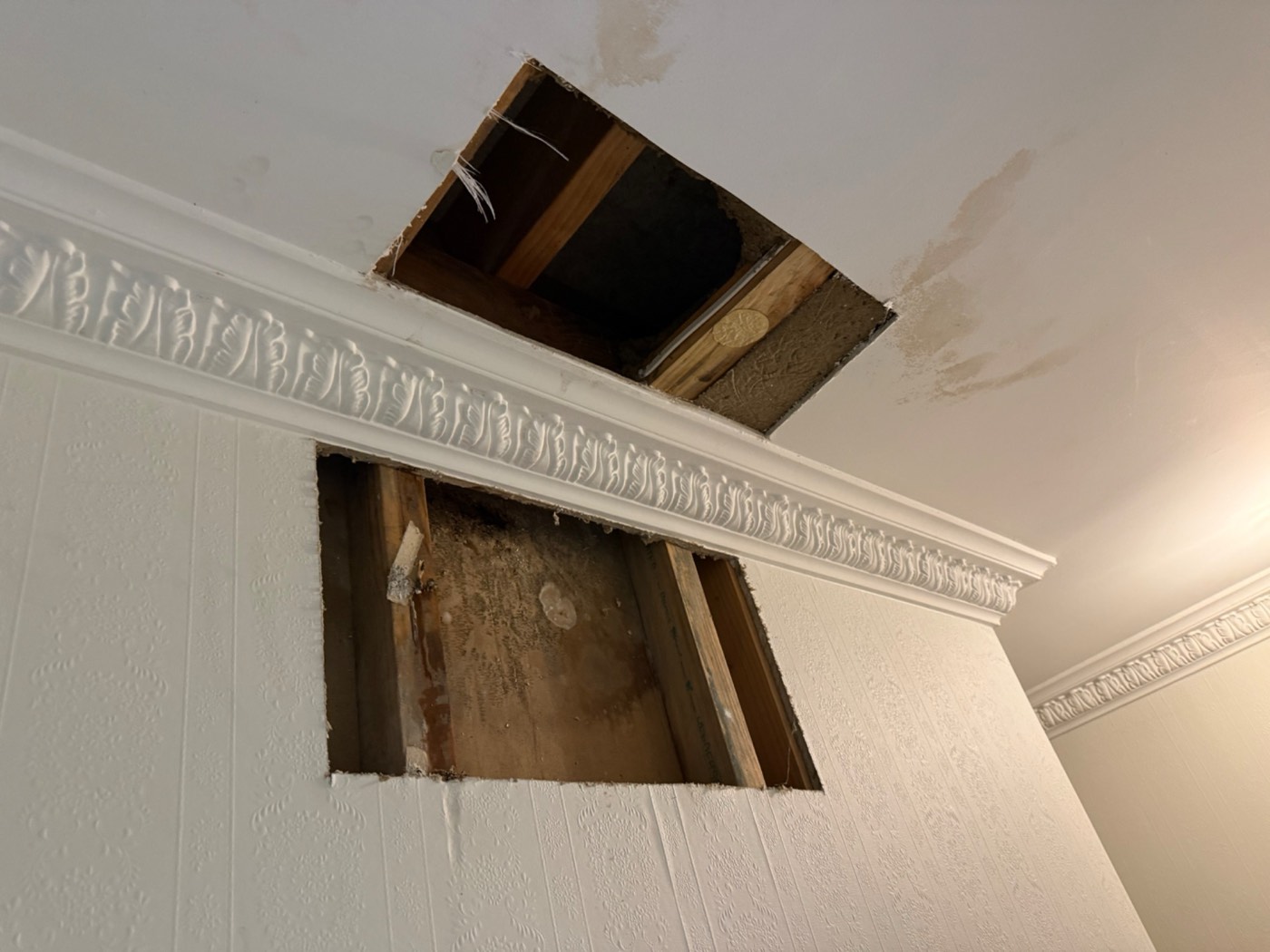
A ceiling in Glenfield. A tenant reported water dripping from the ceiling. We cut the lining open and found the kitchen waste pipe above: the trap had come apart and the waste connections were incorrectly installed and misaligned. Wastewater had been escaping into the ceiling cavity for a considerable period before anyone saw a drop. The parts were cheap. The ceiling was not.
A bathroom in Onehunga. The tenant reported the bathroom flooding whenever the shower was used. We checked the waste, the trap and the water connections and found nothing wrong with any of them. The cause was the shower glass, installed with no nib at the base to hold water in the tray, on a very shallow tray, using a door meant for a tiled walk-in shower. Every part was fine. The assembly was wrong, and the result was water on the floor every single shower.
A toilet in Ōtāhuhu. Reported as a wobbly toilet. The floor fixings had worked loose, and the fill valve had failed at the same time. A wobbling pan grinds at its seal until the connection underneath starts leaking, which is the point where a ten minute job becomes a floor.
The pattern is the same each time. The failure was in how something was fitted, not in what was fitted, and nobody knew about it until the damage was done.
What you can do yourself
Genuinely fine, and worth knowing how to do:
- The meter check. Turn everything off, watch the meter. Here is how.
- Shutting the water off. Find your water meter box and the isolating valves under your sinks before you need them.
- Plunging a blocked sink or toilet, and clearing hair out of a basin waste by hand.
- Cleaning a shower rose that has scaled up, or replacing one that screws on.
- Replacing silicone around a bath or a sink rim.
- Hand tightening a plastic trap nut that has weeped. Hand tight only.
- Changing a washing machine hose, as long as you turn the tap off first and do not over-tighten.
- Looking. Getting a torch out and checking under sinks and around the cylinder twice a year finds more problems early than anything else on this list.
Where to stop
- Anything inside a wall, a floor or a ceiling. Not because it is difficult, but because a mistake there is invisible until it has done months of damage.
- Anything that needs soldering, pressing or crimping. The tools exist to be bought, and the joints still fail if the technique is off.
- Waste pipes and fall. Getting the gradient wrong does not leak, it just slowly stops draining, which is worse to diagnose and worse to fix.
- Hot water cylinders. Valves, relief lines and thermostats involve pressure and scalding temperatures, and cylinders are heavy enough to hurt people.
- Gas. Always. There is no reasonable DIY version of gas work in New Zealand and no repair worth the risk.
- Anything that has to be certified. Sanitary plumbing, gasfitting and drainlaying are restricted work here, and certain jobs must be done or supervised by a licensed person. That is not a formality when you come to sell or claim.
The reason this matters beyond the repair
Insurance. A failure caused by unlicensed work, or one that has clearly been weeping for months, is much harder to claim than a sudden burst. The Glenfield ceiling is the type of case that gets argued over, because the damage accumulated rather than happening in one moment.
Selling. Building inspections find unpermitted and non-compliant work, and it becomes a price negotiation at the worst possible time.
The next repair. Work that was done wrong once has to be undone before it can be done right, and we charge for both.
If you have already had a go
That is genuinely fine, and please do not be embarrassed about it. We would rather be told.
Tell us what you tried and what happened, because it saves us diagnostic time and saves you money. What does cost people is hiding it, since we then spend an hour eliminating possibilities that could have been ruled out in a sentence.
If it is leaking right now, turn the water off and call us.
Common questions
Is DIY plumbing actually illegal in New Zealand?
Much of it is restricted. Sanitary plumbing, gasfitting and drainlaying generally have to be carried out or supervised by an authorised person, with narrow exemptions for minor maintenance such as clearing a blockage or replacing a tap washer. Gasfitting has essentially no homeowner exemption at all. If you are unsure whether a specific job falls inside the exemption, ask before you start rather than after.
Can I install my own dishwasher or washing machine?
Connecting an appliance to existing outlets and taps is normally fine. What catches people out is where there is no existing connection, because adding one means new pipework and a new waste connection, and that is restricted work. The other common problem is over-tightening the inlet hose, which crushes the seal and produces a weep that only shows up under the machine weeks later.
I replaced a tap and now it drips at the base. What did I do?
Usually one of three things: the seal under the tap body is not seated properly, the tap was over-tightened and the washer is distorted, or the flexible tail was done up hard with a spanner rather than hand tight plus a nip. Turn off the isolating valve, take it apart and look at the seal before you tighten anything further, because more force is what caused it.
Why do you charge to fix something that took you ten minutes?
Because the ten minutes is the last part. What you are paying for is knowing which ten minutes, arriving with the right part already on the van, and a repair that is certified and warranted. The job that takes us ten minutes is often the same one that has taken somebody else a weekend and two trips to the merchant.
Is it worth having isolating valves fitted everywhere?
Yes, and it is one of the best small investments in a house. They let you shut off one fixture rather than the whole property, which turns every future tap or toilet job into a quick one and gives you something to reach for in an emergency. Plenty of older Auckland kitchens and vanities have never had them.
Related reading
- A pipe has burst: what to do in the first ten minutes
- Where is my water meter box, and what if the valve will not turn?
- Water under the sink: working out which pipe it is
- A water stain on the ceiling: bathroom above, roof, or something else?
- Flexi hoses: the quiet cause of most household water damage
- Water leaks in Auckland homes: the full guide
The jobs on the do-not list are the ones worth handing over. See what our residential plumbing service covers, or call 021 837 775.