
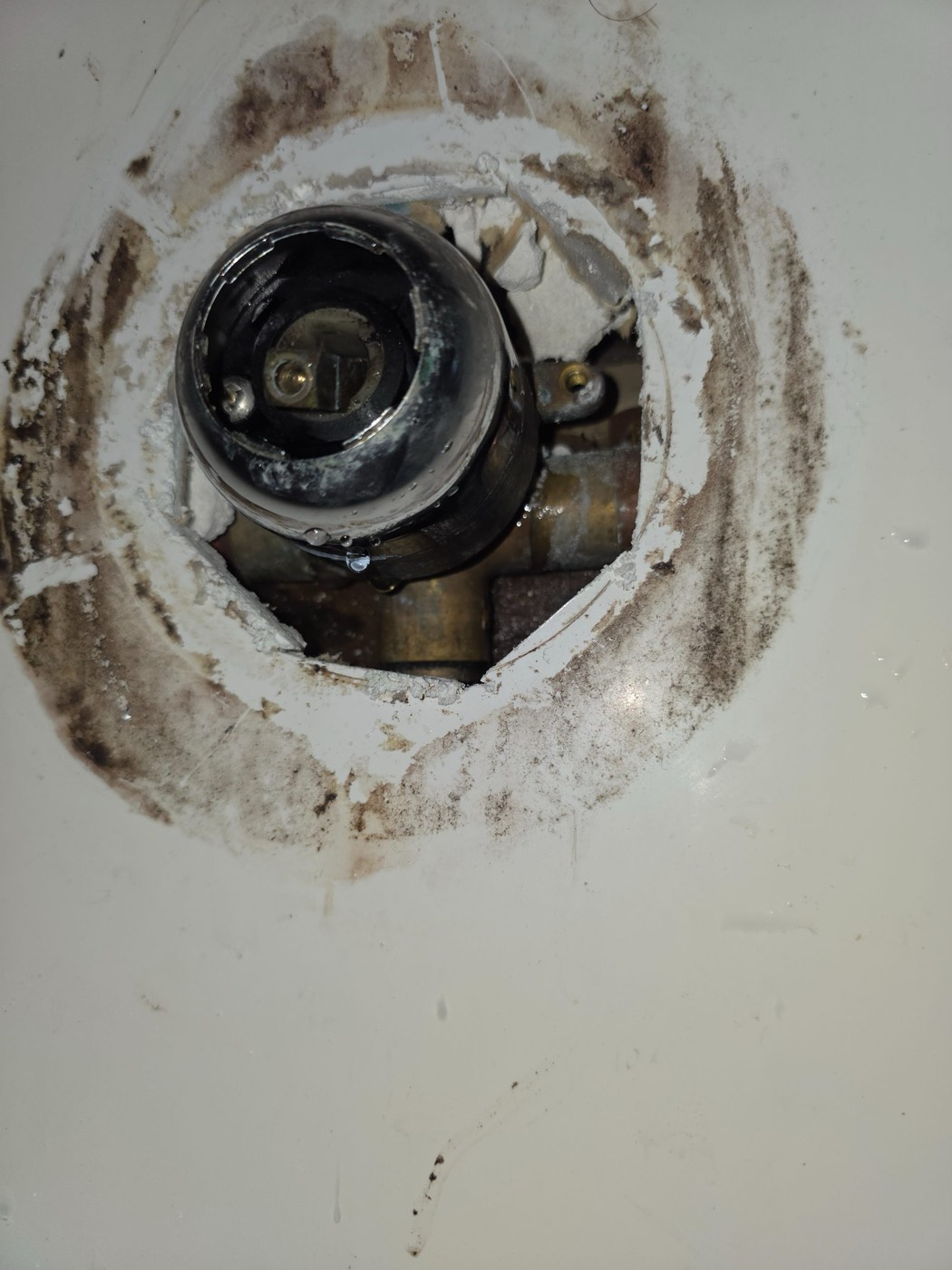
A tenant in Birkenhead reported that water ran out from the shower after every use and went down into the floor below. The shower had been out of use for about a month by the time we were asked to attend.
It took three visits to close out, and the reason is worth explaining, because it is how a leak like this actually gets solved. The shower box had not been installed by a plumber and things that should have been standard were missing, so there was more than one fault to find. Nobody can see through a wall, so you remove possibilities in order, least destructive first.
First visit: the sealant that was never there
We ran the shower and worked from the outside in. The enclosure itself was not the problem. What we found was that there was no silicone where the shower handle and the mixer plate pass through the liner, so every time the shower was used, water was running in through those two openings and straight into the wall.
That is basic. On a shower installed by a plumber it would have been sealed at fitout.
We sealed around the handle and the mixer plate, refitted and tightened the fittings, and tested it. Then we left it with the tenant to use normally and watch, because at that point it was a genuine fault that had been fixed, and there was no reason to open a wall to look for a second one.
Second visit: the mixer itself
The leak came back, which told us what we needed to know. With the openings around the handle and plate now sealed, the water had to be coming from the mixer or the pipework behind it.
We went back with two plumbers and formed an inspection opening, roughly 350 mm square, through the wall lining behind the wardrobe on the other side, which backs onto the shower. Ran the shower, looked in with a torch, and there it was. Water was dripping off the body of the shower mixer.
A mixer leaking from its body has failed internally. There is nothing to reseal and no cartridge that fixes it. We isolated it and made it safe so no more water went into the wall cavity, and the shower stayed out of use until it could be replaced.
Third visit: replacing it, and why this one was not tidy
Normally this is the straightforward part. The usual replacement is a jumbo plate mixer, whose large faceplate covers the opening we have to make to get the old mixer out. Nothing is patched, nothing shows, and the wall is closed by the new tapware itself.
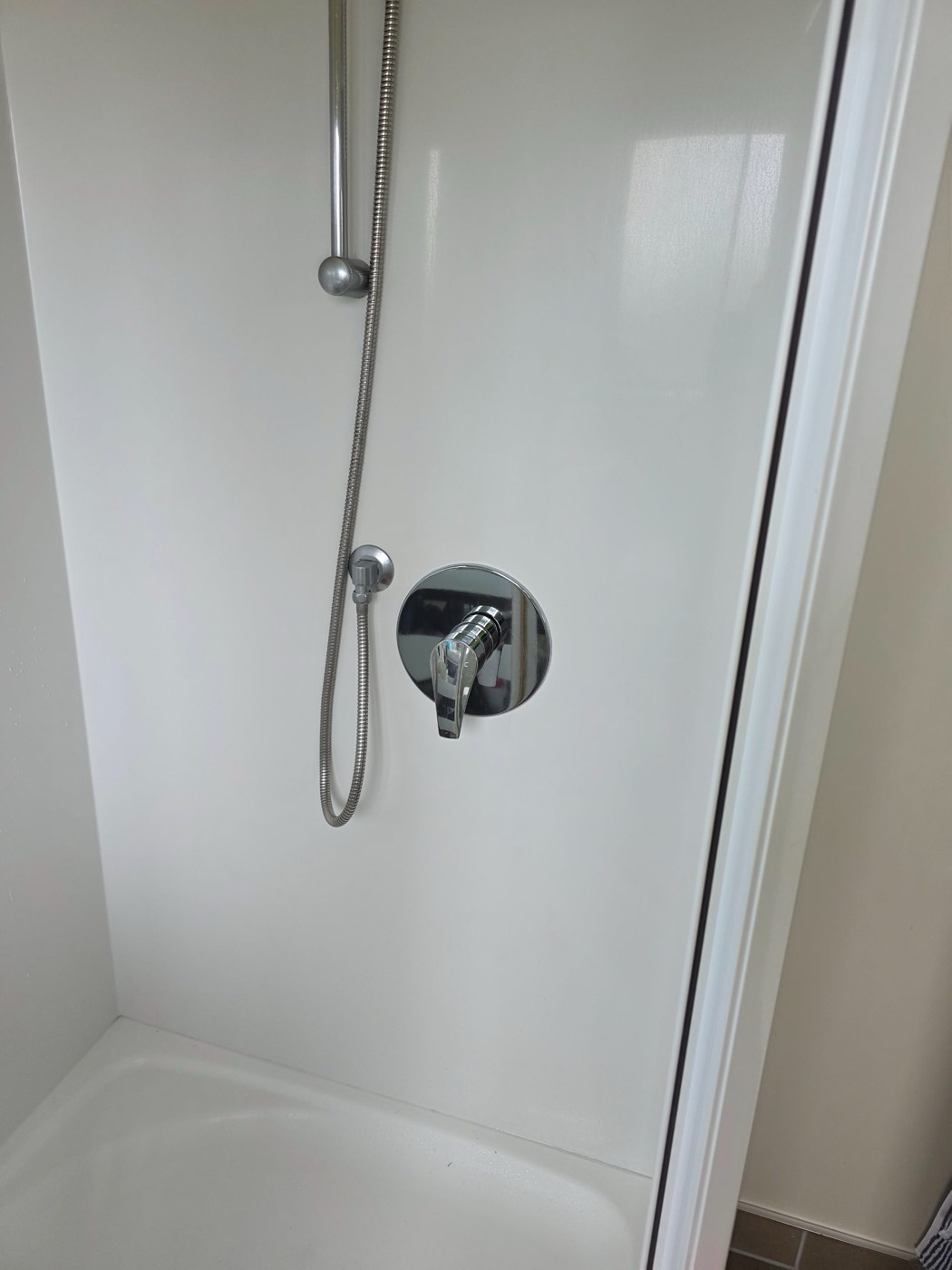
This house could not have that. The hot and cold lines came into the mixer from well apart, so getting the old one out and the new one connected meant opening the liner wider than any faceplate would cover.
So we cut the liner, replaced the mixer on the existing connections, then glued the cut section back and sealed the join. Tested hot and cold, no leaks.
We will say plainly what that is. It is a temporary fix. The shower is watertight and usable now, but a patched liner is not a factory sealed wall, and the real answer at that house is to renovate the bathroom when the owner is ready. Better to know that from the start than to find out the next time it moves.
That is also why two quotes for the same sounding job are not the same number. What is behind the wall decides it, and nobody can see that until it is open.
One outlet or every outlet
A useful check while anyone is in the bathroom, and one you can do yourself before you ring us.
If the shower is weak or never runs properly hot, try the basin and the kitchen. A problem at one outlet is a tapware problem. The same problem at every outlet is a system problem, usually the hot water cylinder rather than anything in the bathroom. On an electric cylinder, water that never gets past lukewarm anywhere in the house normally points to a failed element or thermostat, and those are electrical components that need an electrician.
Telling us which of the two it is when you call saves a visit, and tells us who needs to turn up.
Why leak finding works by elimination
A shower has several things that can let water out, and a badly installed one can have more than one of them wrong at the same time. Nobody can see through a wall, so the only honest method is to remove possibilities in order, cheapest and least destructive first, until one is left.
That is also the answer to why a plumber will not quote a leak repair over the phone. What is quotable is the investigation. What it turns out to be decides the rest.
Before anyone opens anything, these are the ones that narrow it down:
- Water only while the shower runs. Points at the supply side, which is the mixer or the pipework behind it
- Water appearing after every use. Often water getting in at the handle and the mixer plate where they pass through the liner, or past the door and the tray edges. Check whether those are sealed before anything else
- Water when nothing has been used at all. Points at a constant leak on a pipe rather than at the shower
- A damp patch on the other side of the wall, or in the wardrobe behind. Almost always the mixer body or a joint in the wall
- Staining on the ceiling below an upstairs shower. Could be either, and it is worth looking from underneath before cutting anything
- The shower tray edges and the door seal. Cheap to check, and they are the most common cause of water on the bathroom floor
If this is happening at your place
Stop using the shower. Water going into a wall cavity does more damage per day than almost anything else in a house, and it is doing it out of sight.
If you are renting or managing the property, get it looked at rather than waiting to see if it dries up. A month of a concealed leak is framing, lining and flooring, and it is the difference between one invoice and a claim.
Text us a photo of the shower and where the water is appearing, or give us a call. We cover Birkenhead and the North Shore.
Common questions
Can a leaking shower mixer be repaired instead of replaced?
If it is dripping from the shower head or seeping at the handle, that is usually the cartridge and it is a repair. If water is coming from the body of the mixer inside the wall, it has failed internally and no seal or cartridge fixes it. Replacement is the only option at that point.
Why does replacing a shower mixer cost more than replacing a tap?
Because of access. The mixer sits behind a waterproof wall and cannot be reached from the front. Most of the time it is still tidy: we fit a jumbo plate mixer, whose large faceplate covers the opening, so nothing needs patching. It costs more when the hot and cold lines run into the mixer from too far apart for a faceplate to cover the opening, because then the wall surface has to be cut, reinstated and sealed as well. The mixer itself is the smallest part of the bill either way.
How do I know if the leak is the mixer or the shower enclosure?
Run the shower and watch when the water appears. Water that only shows while the shower is running, and keeps coming from inside the wall, points at the mixer or the pipework. Water that appears after every use is more often getting in at the handle, the mixer plate, the door or the tray edges, and the first thing to check there is whether those were ever sealed.
My shower runs warm but never hot. Is that the mixer?
Check another tap first. If the hot water is weak at the basin and the kitchen as well, the fault is the hot water system, usually a failed element or thermostat in an electric cylinder, not the shower. If it is only that one outlet, then the mixer or its cartridge is the likely cause.
My bathroom taps are all original. Should I replace them together?
Not necessarily, but expect them to fail around the same time, because they are the same age and the same quality. When one fails from old age it is worth asking the plumber to check the others while they are there, especially if the bathroom is being redone anyway.
Related reading
- Choosing a tap or mixer in a New Zealand home
- Takanini: chasing a shower leak in a fully tiled bathroom
- Bathroom renovation plumbing in Auckland
- How plumbers find a hidden leak
- Is your leak covered? Avoid this insurance mistake
- Water leaks in Auckland homes: the full guide
A mixer leaking inside a wall does not announce itself until the damage is already done. We cover Birkenhead and the North Shore. Call 021 837 775. Finding it without stripping the wall is what our leak detection service is for.