
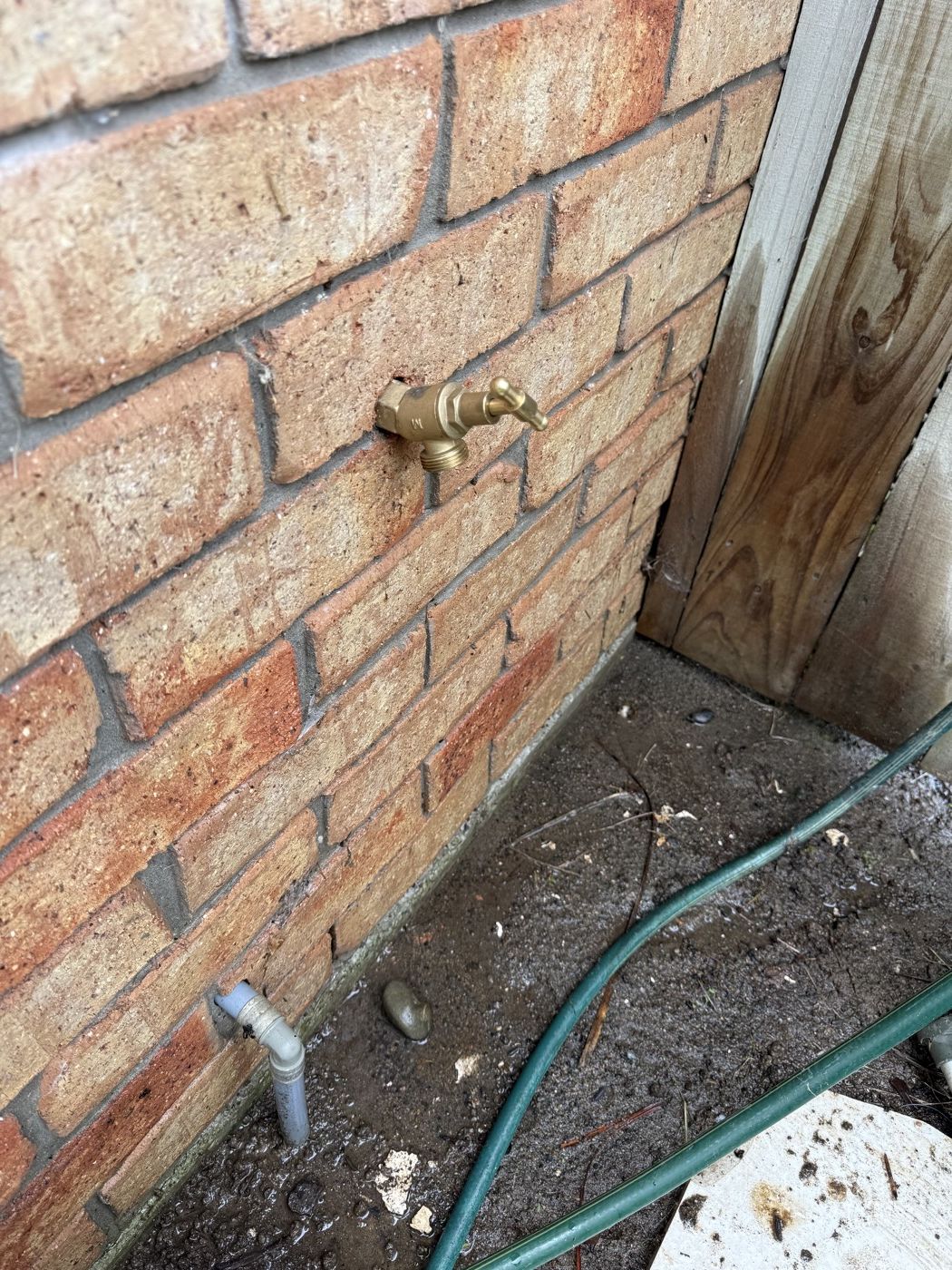
We were called to a Te Atatū South rental because the ground around the garden tap was soggy. Not a drip from the spout, just wet ground that never dried out.
The tap was not the problem. We dug down around the pipe below it, exposed the service line, and found a fitting on the pipe feeding that tap had failed and was leaking underground. We cut the failed fitting out, put a new one in, and reconnected the line.
Then we did the thing that the tap itself needed. It had been sitting there unsupported, so every time somebody screwed a hose on or wrenched it shut, the whole load went into the pipework behind the wall. We fixed it properly to the wall so it has something to push against. Water back on, watched the meter, no movement.
Why hose taps take out the pipe behind them
An outside tap gets treated worse than any other tap in the house. A hose gets yanked sideways, kids hang off it, and because it always seems stiff, people close it harder than they need to.
If the tap is only held by the pipe it is screwed onto, all of that force goes into a fitting you cannot see, sitting in a wall cavity or in the ground.
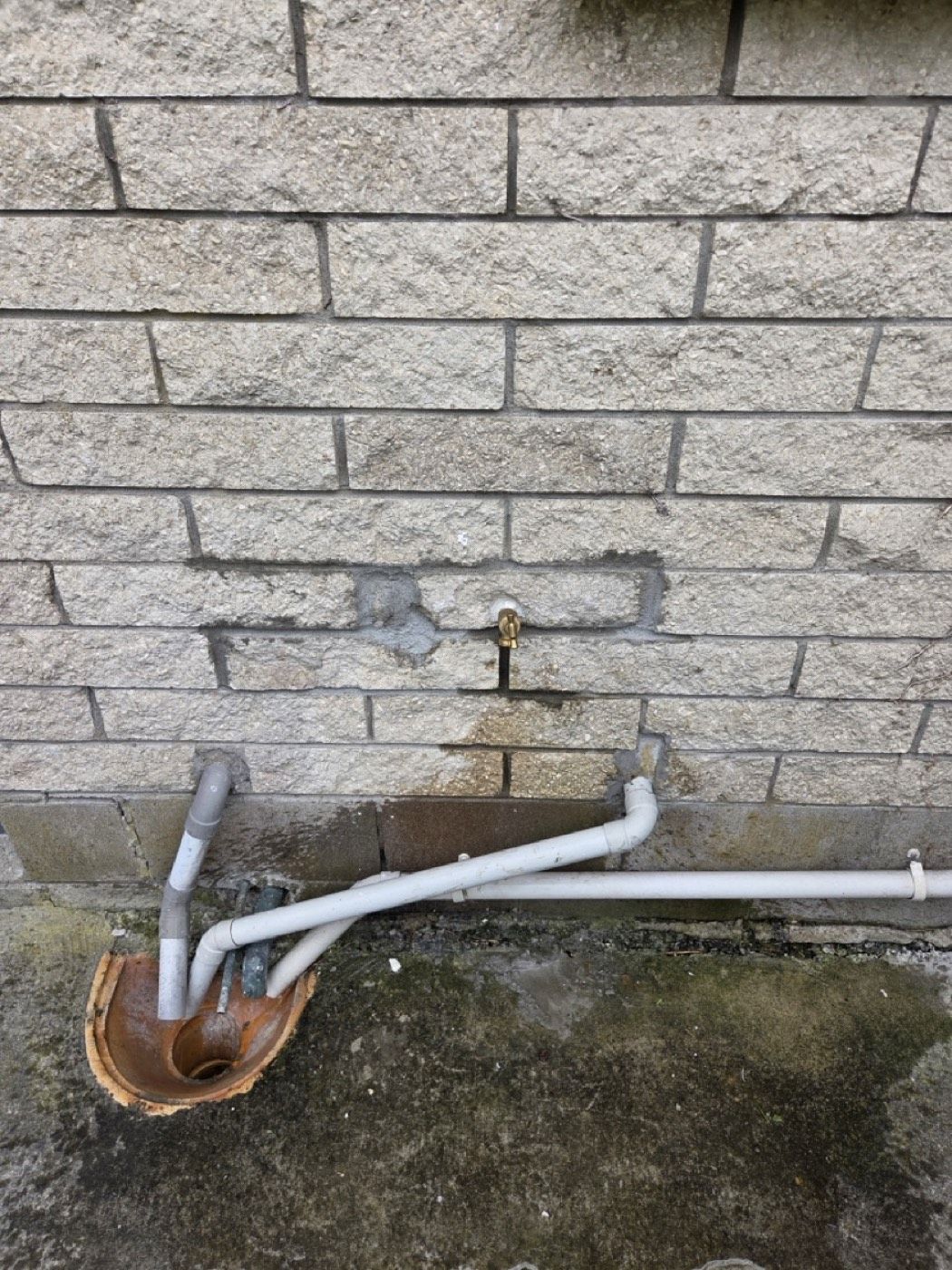
We had a Papakura job where exactly that had happened. The leak was inside a brick wall, and getting to it meant grinding out mortar and brick to reach the copper. We repaired the pipe, capped it and prepared the connection, then the brickwork had to be rebuilt before we could come back and fit the new tap. A tap that had been properly supported and backed would not have started any of it.
So when we install one, it gets fixed to the wall, not just to the pipe. That is the whole difference.
If your water meter is running, check the hose taps first
This is the useful one for homeowners, and it comes from a job in East Auckland where the owner had a running meter and a wet meter box.
We went through the house. Both toilets were fine, the cylinder was fine. Outside, the hose tap was loose and dripping, so we tightened the fitting and the drip stopped. Easy answer, and it was the wrong one.
We cleared the standing water out of the meter box and watched it. The puddle came straight back. That meant water was escaping underground near the meter, which no amount of tightening a garden tap was going to fix. A leak detection survey traced the noise, we marked it, dug it up on a clear day and found a worn fitting on the line. Replaced it, turned the main back on, watched the meter for thirty seconds and it had stopped.
Two lessons in one job. Check the hose taps first, because they are the easiest thing to rule out. And then prove it is fixed with the meter, not with your eyes, because a leak you can see is often not the only one you have.
How to check your own
You can do this yourself in ten minutes:
- Turn off every tap in the house, including the washing machine and dishwasher
- Find the water meter, usually in a box at the front boundary, and look at the smallest dial or the last digits
- Write it down, wait fifteen minutes with nothing running, and read it again
- If it has moved, you have a leak somewhere on your side of the meter
- Walk the outside walls and look at every hose tap and every patch of ground that is greener or softer than the rest
A hose tap that drips from the spout when it is closed is a washer or a worn spindle, and it is a small job. A hose tap that is wet where it enters the wall, or ground that stays wet under it, is the fitting behind it and that is a different conversation.
When the tap itself is just worn out
Not every one of these is dramatic. We replaced a hose tap in East Tamaki that was simply worn out inside from years of use. Isolate, unscrew the old one, fit the new one, test. Half an hour and done.
The parts that fail are the washer, the spindle and the seat inside the body. On a cheap tap they go quickly. On a brass tap fitted with some care, an outside tap lasts a very long time.
What a good outside tap install looks like
If you are having one put in or moved, this is what to ask for:
- Fixed to the wall on a backing plate or bracket, so the pipe behind it carries none of the load
- A brass tap, not the cheapest thing on the shelf, because it lives outside in the weather
- A hose union thread if you actually use a hose, so you are not fighting a leaking connector every summer
- An isolating valve inside where practical, so the tap can be worked on without shutting the whole house down
- Thought about where the water goes. A tap that drains onto a path or against a foundation causes problems that have nothing to do with plumbing
New taps also need to be the right class of tapware for your system, which matters less outside than it does in a kitchen, but still matters if the line is shared.
If the ground is wet and you are not sure
Do the meter test above. If the meter moves with everything off, ring someone before it gets more expensive, because a leak on your side of the meter is your water bill and eventually your foundations.
Text us a photo of the tap and the wet area, or give us a call. We work across Auckland, and we have the gear to trace an underground leak rather than guessing at it.
Common questions
My outside tap is dripping. Is that an expensive job?
Usually not. A drip from the spout when the tap is closed is a worn washer, spindle or seat, and it is either a repair or a straight swap for a new tap. What costs more is when the leak is behind the tap, in the wall or underground, because getting to it means opening something up.
The ground under my garden tap is always wet. Is that the tap?
Often it is not. Wet ground that never dries out points to the fitting or the pipe below the tap rather than the tap itself. The tap can be bone dry while the line feeding it leaks underground. Digging down to expose the service line is how it gets confirmed.
Can a leaking hose tap make my water bill go up?
Yes, and it is one of the more common causes because nobody sees it. Check by turning everything off in the house and watching the water meter for fifteen minutes. If it moves, water is going somewhere. Auckland households can apply to Watercare for a leak allowance in some circumstances once it is repaired.
Why do outside taps keep breaking the pipe behind them?
Because most are held only by the pipe they are screwed to. Pulling a hose sideways or closing the tap hard puts all of that force into a fitting in the wall cavity or the ground. A tap fixed properly to the wall takes the load itself, and the pipework behind it stops being the weak point.
Can I replace an outside tap myself?
The tap head on a simple garden tap is within reach of a confident DIYer if you can isolate the water first. What is not is anything involving the pipe behind it, work inside a wall, or any alteration to the supply line, which is plumbing work. If the wall or the ground around it is wet, that is the situation you want looked at rather than swapped.
Related reading
- Choosing a tap or mixer in a New Zealand home
- Where is my water meter box?
- A one minute leak check anyone can do
- Wet ground and no obvious cause: underground water leaks
- High water bill in Auckland and the Watercare leak allowance
- Water leaks in Auckland homes: the full guide
- The pump will not stop: a tank water job in Kumeū
An outside tap that drips is usually a washer or a seat, and occasionally something behind the cladding. We work across Te Atatu and West Auckland. Call 021 837 775. Outside taps sit under our residential plumbing service.